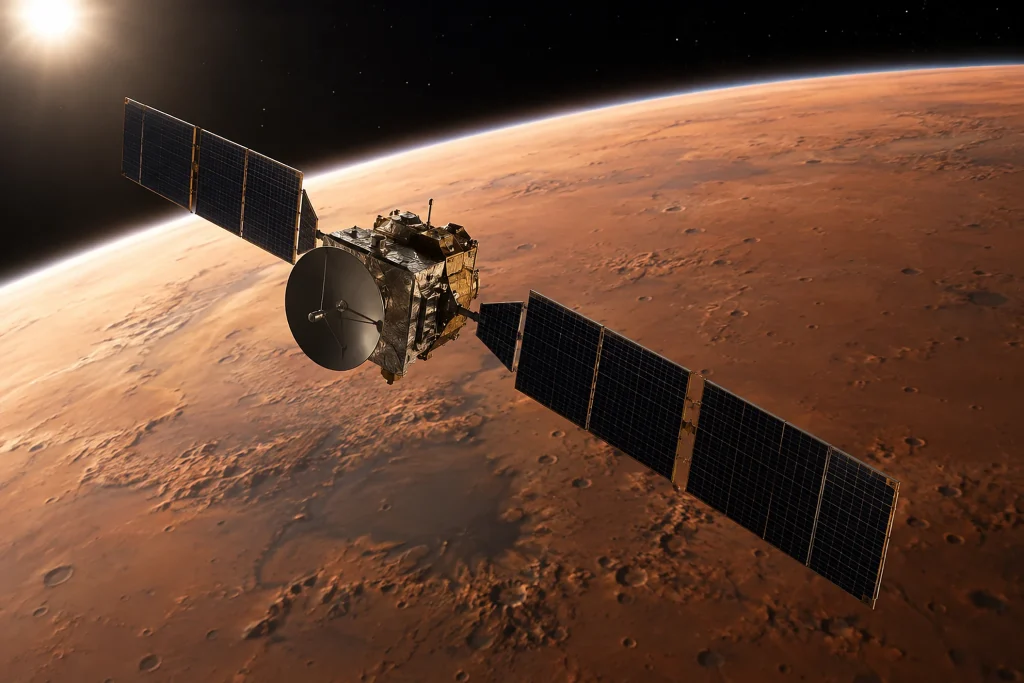
Rocket Lab objected to NASA’s selection of Blue Origin for the “Mars Telecommunications Network” contract. NASA awarded Blue Origin a contract worth $700 million for a spacecraft to be developed, launched and operated at Mars. On Friday, Rocket Lab filed a protest with the US Government Accountability Office, arguing that the decision conflicted with eligibility criteria mandated by Congress and that the review of its technical proposal was punitive and inconsistent. Blue Origin said the protest could delay the planned 2028 launch and that the limited Mars launch windows could jeopardize the timely deployment of critical communications capacity.
The program was established with additional NASA funding under the “One Big Beautiful Bill,” which Congress passed in 2025. The provision, welcomed because of aging Mars orbiters, was drafted under the leadership of Sen. Ted Cruz (R-Texas). The text required the contractor to be selected from US companies that had received funding from the administration in 2024 or 2025 for commercial design studies for Mars Sample Return and had proposed a separate, independently launched Mars communications orbiter supporting an end-to-end sample return mission. Rocket Lab, Blue Origin, L3Harris, Lockheed Martin, Northrop Grumman, SpaceX, Quantum Space and Whittinghill Aerospace were eligible candidates under these criteria.
According to Capitol Hill sources, the phrase “end-to-end” was intended to give Rocket Lab’s proposal an advantage; the company also said in its Q2 2025 investor update that it believed it had submitted the only eligible proposal. Cruz’s office was responsible for the broader text, while Sen. Roger Wicker (R-Miss.) was responsible for the language concerning this program.
It is unclear why NASA selected Blue Origin’s Blue Ring technology. The agency may not have been confident that Rocket Lab could complete its spacecraft and Neutron rocket by the end of 2028, or it may have considered Blue Ring better suited to its needs. However, NASA has not published the “source selection statement” explaining the technical rationale, despite nearly two weeks having passed since the decision.
The process remains uncertain because of the technical proposals, political maneuvering and exchanges between the two companies on social media. This procurement marks the first time NASA has awarded a US company a fixed-price contract to develop and launch spacecraft and operate a network around another planet. For now, Blue Origin has a first-mover advantage in NASA’s future Solar System exploration efforts.
Why it matters
The dispute amounts to a public procurement review of the criteria used to establish the communications capacity needed as Mars orbiters age. The GAO review focuses on how NASA interpreted the conditions Congress set for US companies that received funding in 2024 or 2025 and whether the agency acted consistently in its technical evaluation. The fact that the source selection statement containing the rationale for the decision had still not been published nearly two weeks later leaves unclear which technical factors proved decisive between Blue Ring and Rocket Lab’s spacecraft and Neutron rocket. The fixed-price model’s assignment of development, launch and network operations around another planet to a US company for the first time ties the outcome not only to the current candidates but also to NASA’s approach to commercial partnerships in Solar System exploration.
Background
NASA is not a new name in the FikirPilot archive: over the past 90 days, we published 32 news articles mentioning this name; the most recent was dated September 14, 2026.