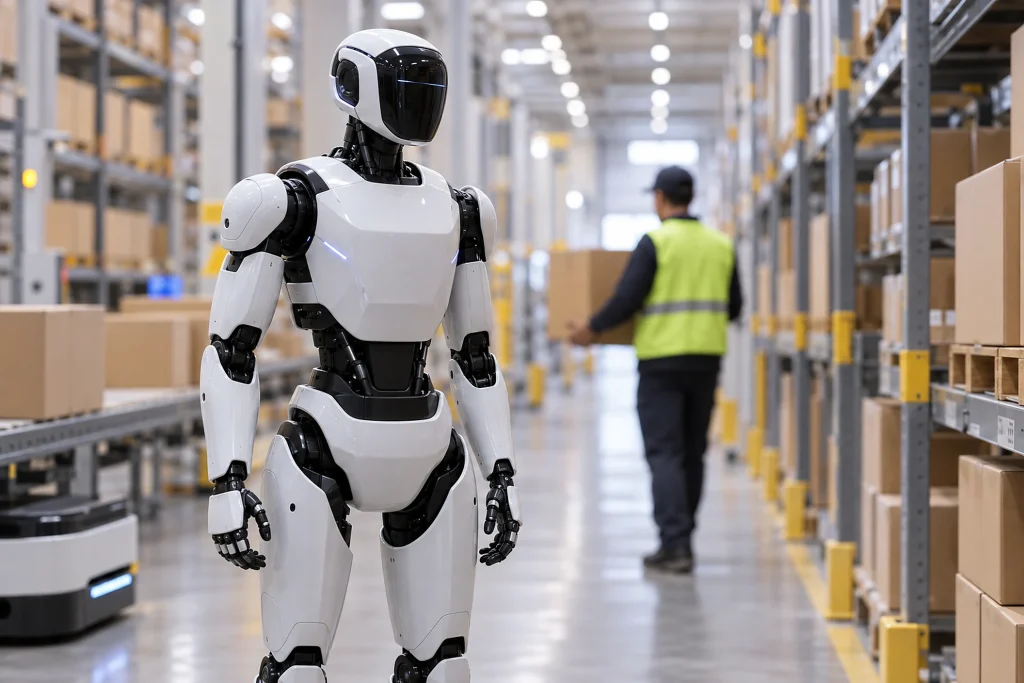
Agility Robotics’ new humanoid robot, Digit 5, will be able to work alongside people without physical cages or safety barriers. When the robot detects a person at a distance, it can change direction or stop to let them pass. If a person gets too close, it can crouch into a seated position. CTO Pras Velagapudi said the safe motion system applies different precautions based on the detected presence of people.
Early access to Digit 5 is planned for the first half of 2027, with general sales expected to begin by the end of the year. The company is reconfiguring its RoboFab facility in Salem, Oregon, for the new model. Agility became the first company to deploy humanoid robots in full-time commercial operations at a GXO warehouse in Atlanta in 2024. Previous Digit models have worked for more than 65,000 hours in warehouses and factories across North America. Customers include GXO, Schaeffler, Amazon, and Toyota Motor Manufacturing Canada.
Digit 5 identifies nearby people using a multimodal system comprising AI algorithms and various visual sensors. It uses Nvidia’s Thor IGX hardware and the Nvidia Halos for Robotics software system for robotic safety applications. Agility is also participating in the development of the ISO 25785-1 standard for industrial mobile robots within the International Organization for Standardization. The standard, which is under committee review, will be put to a vote by the organization’s 89 voting member countries.
The redesigned legs allow the robot to repeatedly lift loads of 50 pounds. Its battery lasts 90 minutes on a single charge and can be recharged in nine minutes, allowing it to operate for more than 20 hours within a 24-hour period. Standing 5 feet, 11 inches tall, Digit 5 can reach a height of 7.2 feet, compared with Digit 4’s reach of 5.5 feet.
Interchangeable grippers and new AI capabilities allow the robot to perform different tasks. Digit 5 will be able to stack products on pallets and package them, pause during pallet changes, and navigate aisles where people are present. The company says proving this “cooperative safety” approach in commercial applications could pave the way for the “collaborative safety” stage, in which robots and people will work directly in close proximity.
Why it matters
A working arrangement that does not require physical barriers reduces the need for areas reserved for robots in warehouses and factories while making safety more dependent on perception and motion systems. Although the previous models’ more than 65 thousand hours of commercial experience show that the approach is not limited to the laboratory stage, the use of Digit 5 alongside people without barriers still needs to be proven in the field. Load capacity, reach, fast charging, and interchangeable grippers make it easier to adapt the same robot to different tasks such as stacking, packaging, and transport within aisles. The ISO 25785-1 initiative shows that common safety rules will be decisive in the widespread adoption of such systems. However, the standard’s voting process and the conditions under which direct collaboration in close proximity will be possible remain open questions.