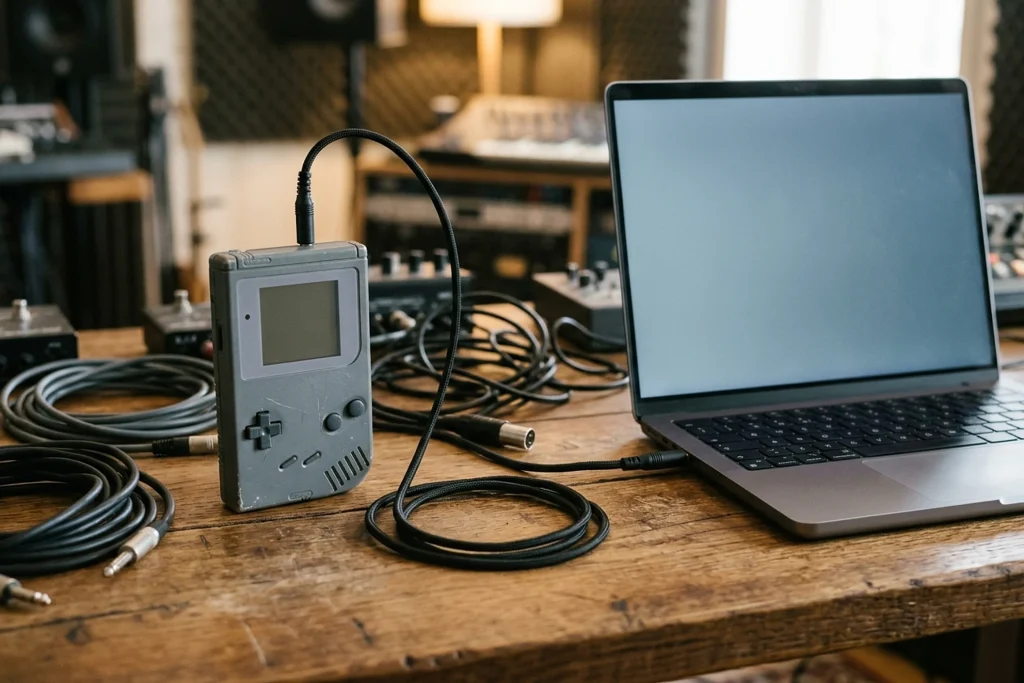
It’s possible to use an unmodified GBA as a music synthesizer. Modern games like Undertale still imitate the style and sound of old video games today. Celeste and Shovel Knight are also examples. The chiptune community usually modifies hardware to produce music on old systems, but the synthesizer developed for the Game Boy Advance requires no changes to the console at all. The system’s secret is the multiboot feature. This feature lets friends play multiplayer without a cartridge, while also making it possible to send executable code to the console via a link cable. Setup begins with a computer. The console is connected to the computer, the software starts, and when the GBA is powered on, the program automatically loads the synthesizer into RAM. Sound comes from the headphone jack. The computer and console provide the controls together. The sounds in Andy’s video are impressive. For those who don’t want to take apart a Sega Genesis, this method offers an ideal starting point for making music.
Why it matters
Until now, chiptune production has mostly required physically modifying consoles; this project removes that barrier by turning an untouched Game Boy Advance directly into an instrument. In a landscape where titles like Undertale, Celeste, and Shovel Knight keep interest in retro game sounds alive, those who want to produce those sounds can now get started without modifying any hardware. Adapting the multiboot feature, which was designed for multiplayer gaming, to music production shows that old hardware can gain new functions through software alone. On the other hand, the need to load the program from a computer into RAM at every startup and the way controls are split between the computer and the console reveal that the system remains a computer-assisted setup rather than a standalone instrument. The project therefore appeals especially to hobbyists who are reluctant to take apart a Sega Genesis and are looking for a low-risk starting point.