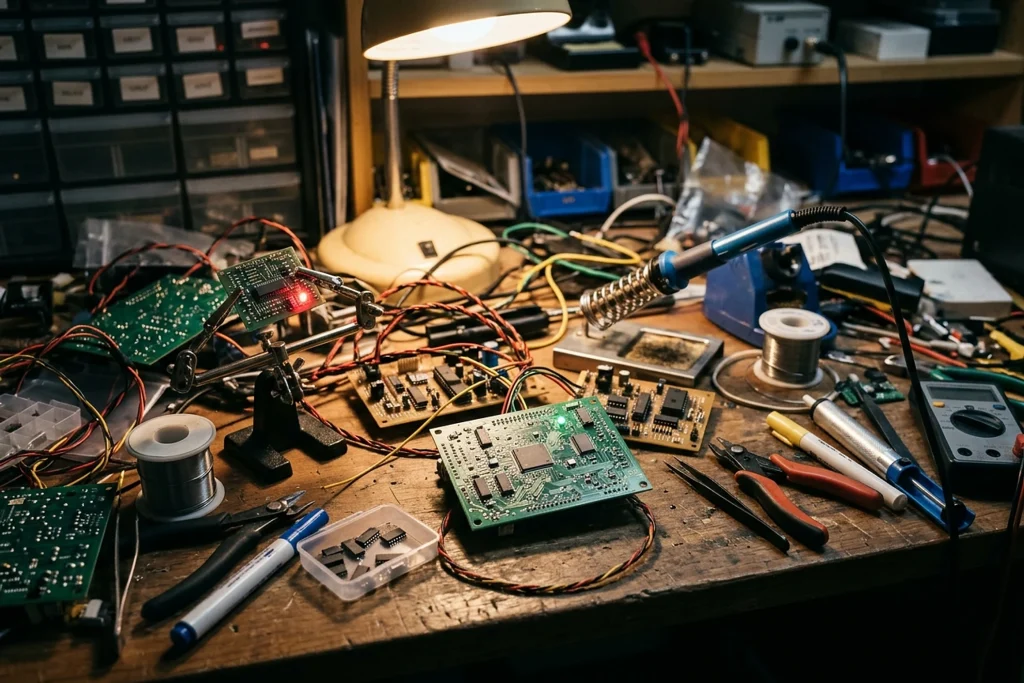
“Making for Others” is the subject of a Hackaday article. Addressing the culture of sharing in the open-source hardware community, the article explains makers’ gifting designs to one another without expecting anything in return not only through self-sacrifice, but also through the joy of sharing with people who understand the work.
At the center are the Supercon badge prototype and SAOs. While the small, inexpensive, and creativity-reflecting nature of SAOs makes them ideal for gifting, [Tom]’s praise of the SAO also cites as an advantage that they teach “full-stack” PCB production at a small scale. It is emphasized that in the SAO ecosystem, as much as is given — and even more — is received back.
The boards on the workbench also appear in the article. Among them are a Raspberry Pi Pico clone produced by Hack Club high school students, along with [CNLohr]’s ch32v003fun board and the esp32s2-funprog programmer. The author says they prefer these development boards on their workbench over commercial alternatives because they know the people who made them.
Production for Supercon is ongoing. The Hackaday team is producing 1,000 badges for this year’s Supercon, and because sponsors cover the costs, designs that the budget would not otherwise allow are also made possible. The event will take place in two weeks.
The newsletter’s history is also mentioned. This article constitutes one of the pieces of content in the Hackaday newsletter, which has been published every seven days for more than 200 weeks.
Why it matters
This article serves as a reminder that open-source hardware is not merely a technical choice but also functions as an economy built on unconditional gifts; the sustainability of this model depends on the existence of a community that understands the design and is willing to give back. Low-cost SAOs’ teaching end-to-end PCB production at a small scale creates an accessible learning channel for those new to hardware. The fact that a board produced by Hack Club high school students is preferred over commercial products on an experienced author’s workbench shows that this trust-based network can also bring student work into the same circulation. The 1,000 Supercon badges covered by sponsors demonstrate that designs the budget would not allow are only possible with external funding. The question that remains open is how portable this gift culture is without sponsor support and face-to-face relationships.