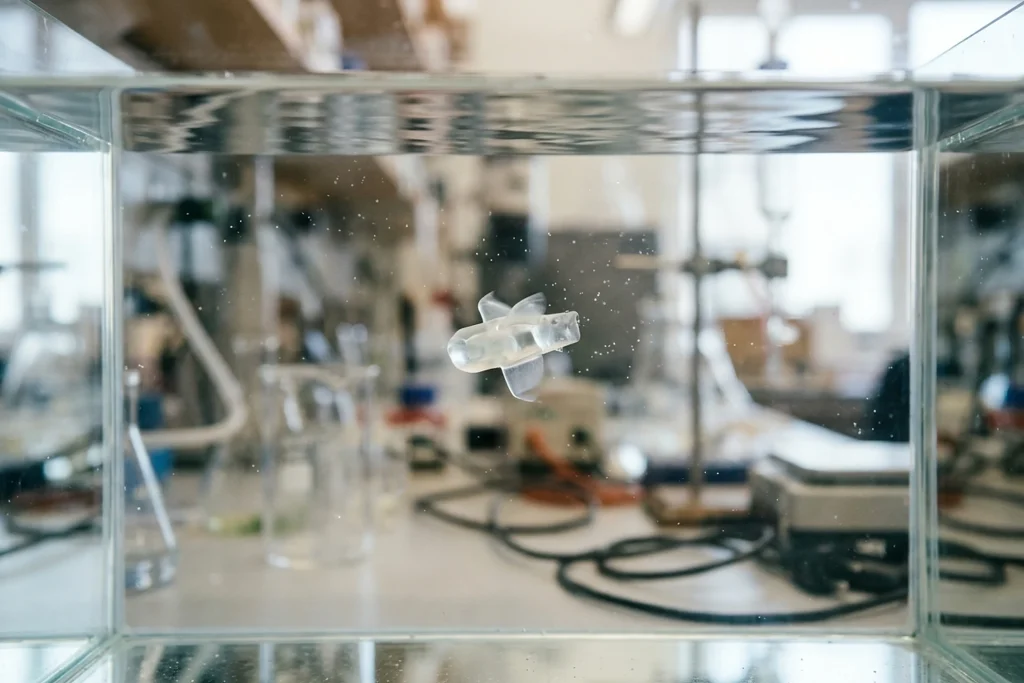
MIT scientists have developed a tiny robot that can swim by harnessing living muscle cells. The device, unveiled in a study published in the journal Advanced Functional Materials, was designed as an extremely thin swimming robot with a flexible gel skeleton the size of a stick of gum. The skeleton is a flexible gel. This gel forms two fins, each coated with a layer of muscle cells much thinner than a human hair. The genetically modified cells contract when exposed to light, and the robot’s speed and direction are controlled by adjusting which fin the light is directed at and how frequently.
In experiments, the robot was able to swim and turn through a simple underwater maze. At top speed, it covered roughly four times its own body length per minute. While this speed is much slower than that of Olympic swimmers, who can cover 65 body lengths per minute, it was comparable to the pace of a leisurely swimming nurse shark. Study author Ritu Raman, an associate professor of mechanical engineering at MIT, said that moving through water requires far more power than moving through air and that the robot is quite powerful for its size.
This is a first of its kind. The device is the first very thin, two-dimensional robot capable of moving with living muscle tissue. Existing biohybrid robots are bulky. These robots typically rely on bulky three-dimensional skeletal muscle structures grown in the lab that require millions of cells. Thinner designs could be more efficient. Raman says these designs could reduce production costs and increase movement efficiency, and emphasizes that muscle-powered robots could one day take on delicate tasks in fragile environments, because living tissue is soft, responsive to its surroundings, and able to repair itself; the team included first author Maheera Bawa, along with Arielle Berman, Laura Schwendeman, Ferdows Afghah, and Seanbiron Johnson.
The robot builds on work from Raman’s lab last year. In that study, the researchers developed an artificial muscle disk inspired by the human iris, in which muscle cells grown on a grooved gel disk extending outward from the center in concentric circles contracted in different directions in response to light. The range of motion was very small. These movements, limited to about 100 microns, remained at a very small scale from a robotics standpoint.
The goal in the new project was to produce contractions strong enough to propel the robot through water. The extremely soft fibrin gel used in the previous study was shrinking rapidly under the force of the contracting cells. The team redesigned the material. The team optimized the gel’s chemical composition and stiffness, then rearranged the channel geometry. Square-based channels produced a different result. Muscle cells were observed to align more uniformly in square-based channels and fuse into fibers, generating stronger, more coordinated contractions. Gelatin methacrylate (GelMA) was chosen instead of fibrin. Gelatin methacrylate (GelMA), widely used in tissue engineering, was preferred because stiffer gels yielded better results. A thickness of about half a millimeter provided the ideal balance. A kind of “exercise” involving repeated light stimulation strengthened the muscle tissue before it was attached to the robot.
The two fins operate independently. The completed robot’s two fins can be activated independently of each other with light, and the tests were carried out in a large water-filled petri dish, by steering the robot through a maze with a manually moved light source. The researchers want to increase its speed. The researchers now plan to improve the body design to increase speed, and the technology is said to be usable in areas such as environmental monitoring in aquatic environments. The research was partially funded by the Office of Naval Research.
Why it matters
This study shows that it is possible to move beyond the established approach in biohybrid robotics, which relies on bulky three-dimensional muscle structures requiring millions of cells; the thin design’s reduction of production costs and increase in efficiency could open up this laboratory-scale technology to a wider range of research teams. Production details such as the gel’s chemical composition, the channel geometry, and the exercise performed with light amount to a direct roadmap for tissue engineers who want to build similar systems. On the other hand, the fact that the robot was steered with a manually moved light source leaves open the question of how control would be achieved under real-world conditions for envisioned uses such as delicate tasks in fragile environments or environmental monitoring. The fact that the research was partially funded by the Office of Naval Research shows that the interest is not only academic, but that underwater technologies are also being looked at from the military domain. The team’s plan to improve the body design to increase speed is the first technical threshold that must be crossed before these questions are answered.
Background
Scientists is not a new name in the FikirPilot archive: we have published 6 news stories featuring this name in the last 90 days; the most recent one is dated October 13, 2026.