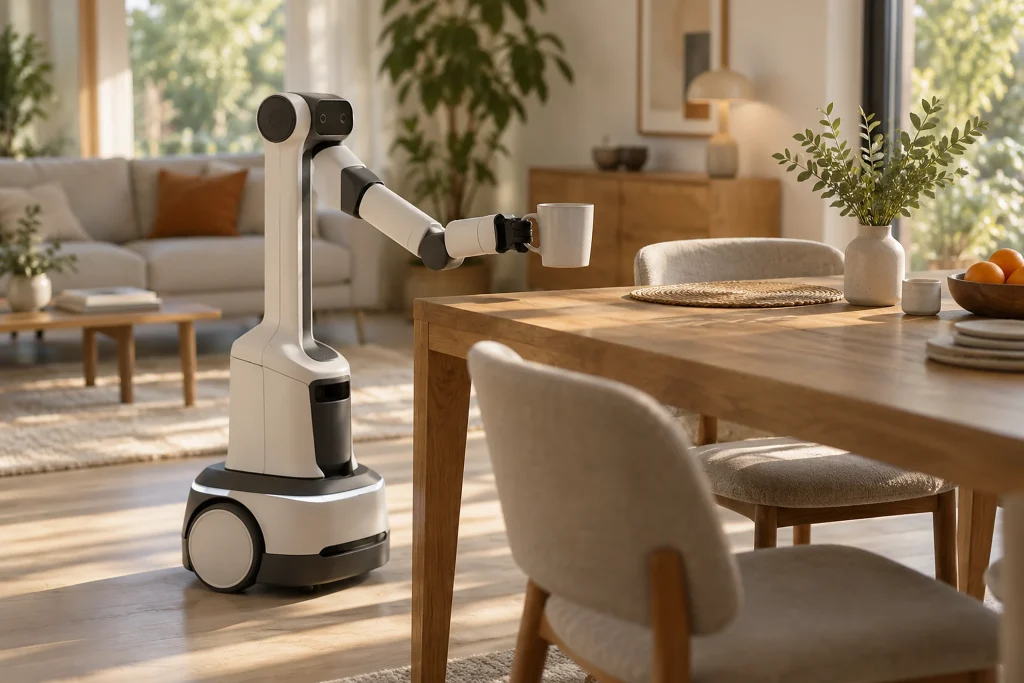
As the co-founder and chief technology officer of Hello Robot, Charlie Kemp is developing mobile manipulators to help people live more independently in their homes and workplaces. Kemp’s interest in robotics began with a search for solutions to the major challenges of artificial intelligence, and at MIT he pursued work ranging from humanoid robots to assistive robots for older adults and people with disabilities. At Hello Robot, where he develops non-humanoid robots with Aaron Edsinger, Kemp places importance on the community discovering new applications for Stretch robots as research and development platforms.
According to Kemp, finding human support is becoming more difficult in aging societies; robots can improve quality of life and strengthen individuals’ independence. However, developing useful and easy-to-use robots requires understanding users’ real-life needs. Kemp notes that seemingly simple needs, such as relieving an itch or picking up an object that has fallen to the floor, can be important, and says that in some cases, having greater control may be preferable to full autonomy. He emphasizes that this knowledge can be gained not merely by programming in the laboratory, but by bringing robots together with people in the real world.
As an undergraduate, Kemp turned to artificial intelligence at MIT through Prof. Rod Brooks’s Cog project. In Brooks’s laboratory, he worked with his co-founder, Dr. Aaron Edsinger, on a humanoid robot called Domo. In 2006, the pair won the best paper award at the IEEE-RAS International Conference on Humanoid Robotics for their work on a system that enabled Domo to help a person place objects on a shelf. This work led Kemp toward assistive robotics and helped him secure a faculty position at Georgia Tech.
Kemp’s academic laboratory studied robots that provided physical assistance with tasks such as eating, hygiene, and dressing. In 2010, Henry Evans seeing the laboratory’s research on CNN launched an ongoing collaboration with Jane Evans through Robots for Humanity. The contributions of Henry Evans, who has severe quadriplegia, and Jane Evans influenced the development of mobile robotic arms that could be used in the daily lives of people with disabilities and inspired Hello Robot’s idea for a home robot. The Evanses used every generation of Stretch, particularly Stretch 4. Kemp also notes that Stretch’s ability to enable Henry to present Jane with a rose showed that simple movements can have a powerful emotional impact.
Why it matters
This approach shows that assistive robots should be evaluated not only by making them technically more autonomous, but also by understanding what kind of support people actually want in daily life. For older adults and people with disabilities, the issue is to develop not merely a machine that performs tasks on its own, but a tool that helps people retain control over their own decisions and mobility. For this reason, users encountering robots outside the laboratory is becoming a complementary part of the design process; real-world use reveals the value of seemingly simple needs and the level of control people prefer. Using Stretch as a research and development platform also allows different communities to explore new applications. The open question is how these experiences can be turned into solutions that are easy for everyone to use.