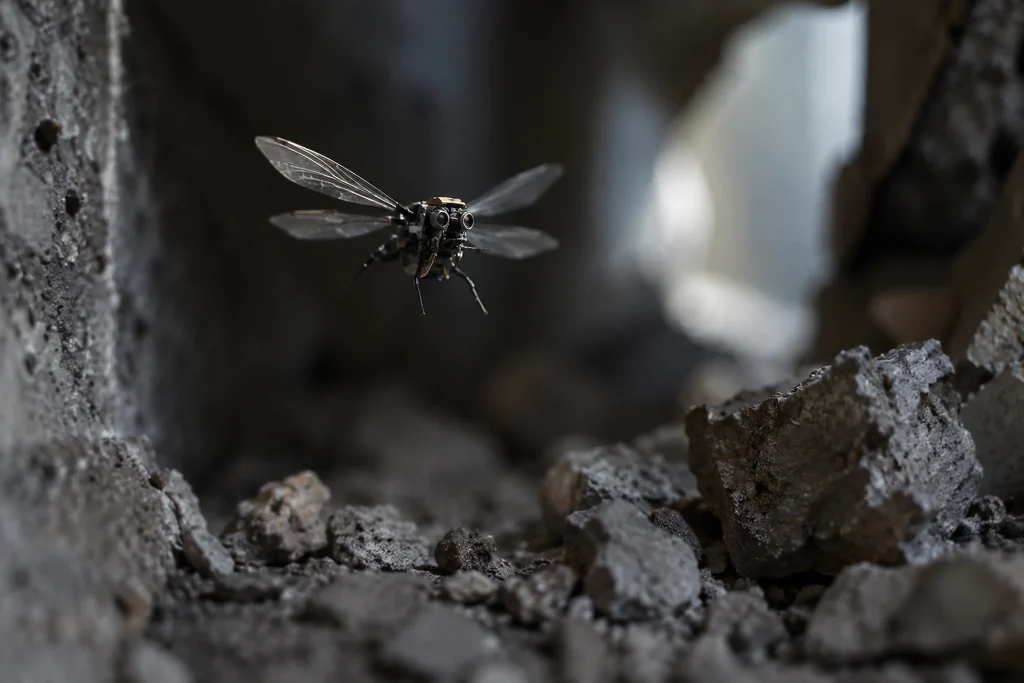
MIT researchers have developed an AI-based control system that increases the speed and agility of insect-sized flying robots that could be used to search for people trapped under rubble. The small robots are intended to navigate through narrow spaces that large drones cannot enter, avoiding walls, debris and falling objects.
The team, led by Kevin Chen, developed a more durable version of the robot, which is approximately the size of a microcassette and lighter than a paper clip. The robot, which has larger wings, flies using soft artificial muscles that rapidly contract and relax. The researchers noted that despite physical improvements in earlier designs, the control system governing the robot’s movements remained a significant limitation.
The new system is based on a two-stage AI architecture. In the first stage, a model-predictive controller that forecasts the robot’s movements using a mathematical model plans challenging maneuvers such as flips, sharp turns and sudden changes in body angle. The system also takes into account the limits of the force and torque the robot can generate. In the second stage, the data produced by the first controller is used to train a deep learning-based “policy” model. This transfers the more computationally intensive planning to a faster model capable of operating during real-time flight.
In experiments, the robot’s speed increased by 447%, while its acceleration increased by 255%. Despite the wind attempting to alter its course, the robot performed 10 consecutive flips in 11 seconds and deviated approximately 4 or 5 centimeters from the planned flight path. The team also demonstrated the “saccade” movement seen in insects, which enables the body to rapidly tilt into a new position and then stop by tilting in the opposite direction.
Researchers aim to enable robots to fly outdoors in the future without relying on external motion capture systems by equipping them with onboard cameras and sensors. They will also examine whether the sensors can help multiple robots move without collisions and proceed in a coordinated manner. The study was published in Science Advances.
Background
MIT is not a new name in the FikirPilot archive: we published a news article mentioning this name in the last 90 days; that article is dated August 26, 2026.