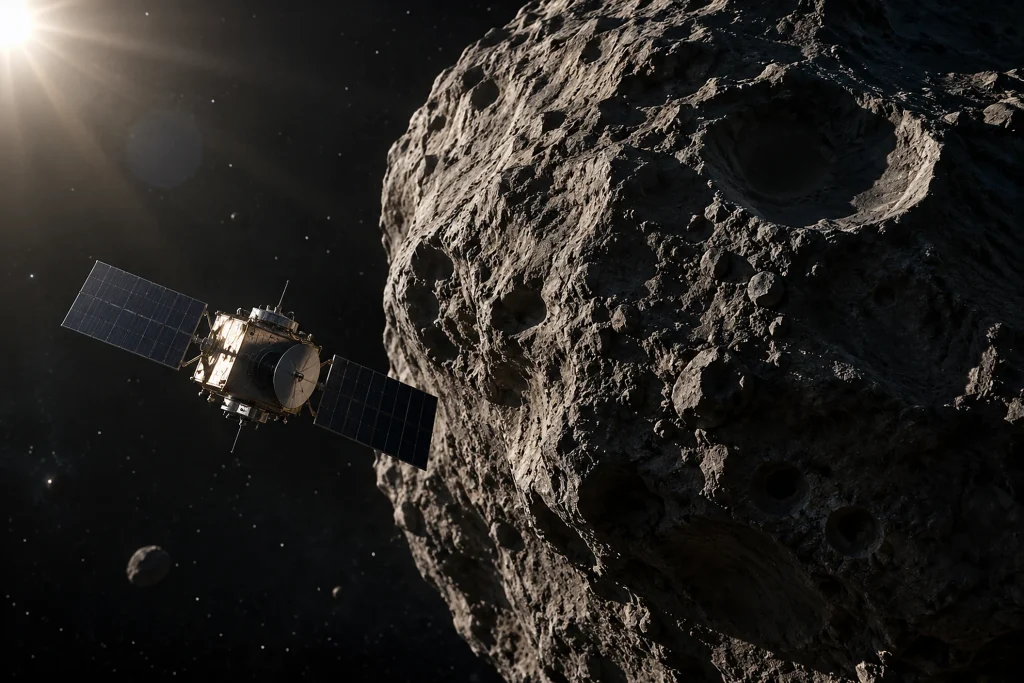
Asteroid mining technology developer AstroForge has developed an AI-powered autonomous control system called “Solo” to make its spacecraft less dependent on flight control teams on Earth. The system developed by the company combines a transformer-based model with traditional control algorithms.
NASA’s OSIRIS-REx mission, which rendezvoused with an asteroid in 2018, had 100 operators working on each eight-hour shift. AstroForge said startups do not have the resources to operate at this scale and plans to send its first autonomous spacecraft on the first rocket to be launched by Stoke Space in 2027. The mission, which will be supported by NASA, is expected to collect scientific data about the Sun.
The company was founded in 2022 and raised $56 million through venture investments. However, anomalies occurred in the two prototype spacecraft it launched, preventing most of the mission objectives from being achieved. AstroForge struggled to communicate with Odin, which was sent into deep space in 2025, and ultimately failed to take control of the spacecraft. This experience raised the question of whether the spacecraft could carry enough intelligence to solve problems on its own. The company is evaluating this approach against the approximately $200 million cost of establishing a ground network by placing five antennas around Earth.
According to flight software director Armand Awad, Solo consists of models trained on test data from subsystems such as power generation and navigation, alongside traditional algorithms, as well as a general intelligence layer trained using approximately 2,500 sensors on the spacecraft. The system aims to detect and resolve anomalies such as loss of position or power problems caused by the star tracker.
AstroForge’s third spacecraft, DeepSpace-2, is expected to launch by the end of 2026 alongside Intuitive Machines’ third lunar mission. Solo will be tested in “shadow mode” on this mission. For the subsequent Autonomy-1 mission, the company currently plans not to use radios capable of receiving commands from Earth.
Why it matters
This approach raises the question of whether startups with limited resources can conduct space missions without large teams and global ground networks. However, the anomalies experienced by AstroForge’s previous two prototypes show that autonomy is not merely a choice that reduces costs, but one that tests mission reliability. The shadow mode test on DeepSpace-2 will provide an intermediate stage in which the system can be evaluated under real mission conditions before directly implementing its decisions. Subsequently, the plan not to use radios capable of receiving commands from Earth will make the ability to detect and correct failures one of the mission’s key determinants. The open question is whether this system, drawing on approximately 2,500 sensors and subsystem data, can make reliable decisions without human intervention in unexpected situations such as communication or power problems.