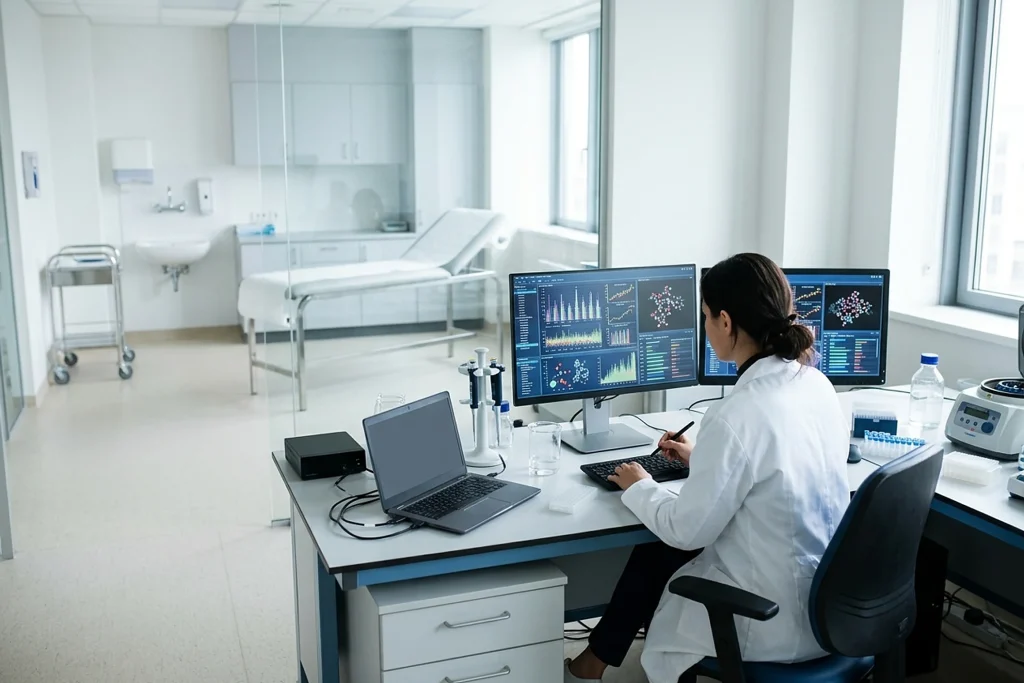
Microsoft’s Mustafa Suleyman said the company’s AI outperforms doctors on difficult cases as it pursues its “medical superintelligence” goal. The system demonstrated this in a simulation. Microsoft’s AI diagnostic system MAI-DxO (DxO for short) diagnosed complex medical cases in a simulation with more than twice the accuracy of general practitioners, according to research published Thursday in the journal Science. Microsoft AI CEO Mustafa Suleyman described the result as a step toward “medical superintelligence.”
DxO works like a panel of doctors. Working like a panel of doctors, these AI agents question the patient, order tests and debate the diagnosis throughout the process.
The gap between the figures was large. In a simulation using complex cases taken from the New England Journal of Medicine, the system achieved 83% accuracy, while general practitioners and internal medicine specialists working individually with reference materials remained at 36%. The comparison had its limitations. Cases this complex, however, are normally handled by specialists or teams that were not part of the comparison. Dominic King, vice president of health at Microsoft AI, said the biggest problem in healthcare is the mismatch between the supply and demand of expertise. With this result, Microsoft joined Google and OpenAI, which claim their AI can rival doctors.
Model performance varied. Microsoft tested DxO with models from OpenAI, Google, Anthropic, Meta, and DeepSeek. The best results came from GPT-5 and GPT-5.5. On its own, GPT-5 reached 78.9% accuracy at a cost of roughly $8,400 per case. DxO lowered the cost by about $3,000 while improving accuracy by only four points. Paired with GPT-5.5, which was released in April 2026, DxO raised accuracy on complex cases from 72% to about 87% and reduced the cost slightly. Gemini 2.5 Flash stood at 46.4% on its own, rising to roughly 69% with DxO. Still, the gap between weaker and stronger models was larger than the gain DxO provided. In emergency department cases, however, no meaningful improvement was seen. Both conditions achieved roughly 85% accuracy.
Suleyman laid out the plan. Suleyman announced that Microsoft is developing a healthcare-specific foundation model with Mayo Clinic and plans to release it next year. He said he believes that in 2027 medical records will be on the verge of “a breakthrough similar to the one in coding,” and predicted that health models will improve “many times over” in capacity within 24 to 36 months.
The two later worked together. Suleyman, a co-founder of DeepMind, founded DeepMind Health with King after Google acquired the company in 2014 and King’s startup Hark was also acquired the following year. Suleyman joined Microsoft in 2024. King followed him a few months later.
The scope of the evaluation is expanding. Through a new partnership with Beth Israel Deaconess Medical Center in Boston, DxO’s clinical reasoning will be evaluated in different hospital settings. In parallel with patients receiving standard care, those who give consent will also interact with DxO, and its recommendations will be compared with those of human doctors. Google also published a study in The Lancet this month evaluating its diagnostic AI, called AMIE, with Beth Israel. Microsoft already sells dictation and radiology tools to clinicians and sees DxO as an extension of these efforts.
Why it matters
This development shows that the AI competition among tech giants is moving into healthcare; Microsoft and Google testing their diagnostic systems with the same hospital is a concrete sign of this race. Since the results are still based on simulation, the system’s value on real patients will become clear through the comparisons in the Beth Israel partnership. The findings are of greatest interest to health systems struggling with a shortage of specialist physicians and hospitals under cost pressure, because Microsoft’s core claim is to close the gap between the supply and demand of expertise. On the other hand, the fact that the gain provided by DxO remains smaller than the difference created by the choice of the underlying model, and that no improvement was seen in emergency department cases, leaves open the question of where the technology will prove useful. The products Microsoft already sells to clinicians also make this effort a commercial expansion step.
Background
Microsoft is not a new name in the FikirPilot archive: over the last 90 days we have published 26 stories mentioning this name; the most recent is dated October 22, 2026.