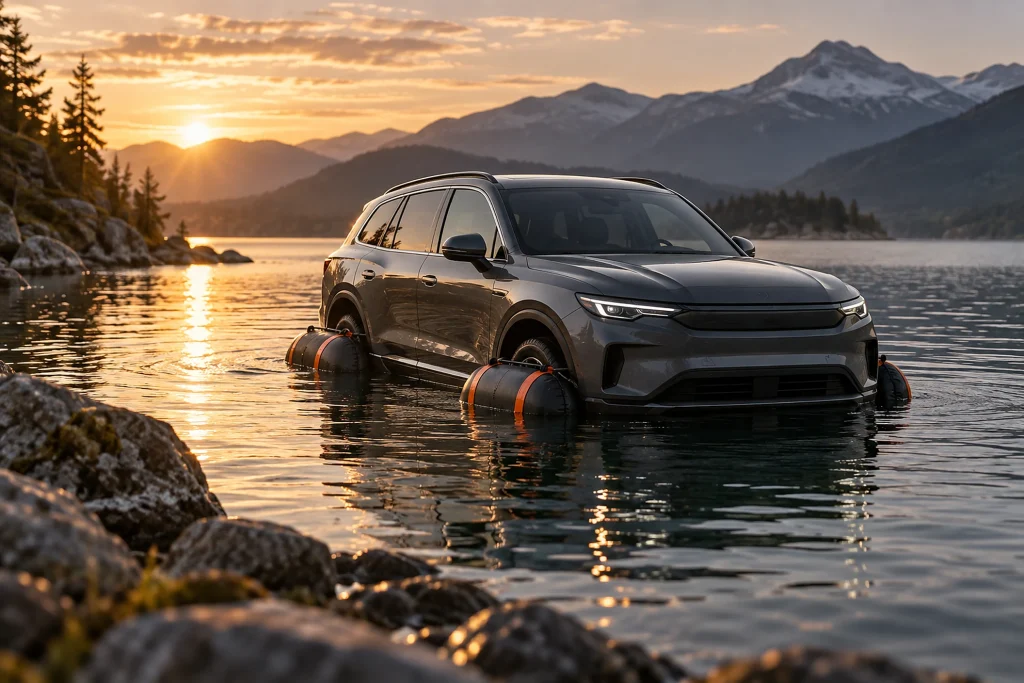
Mercedes-Benz Group AG registered a patent for an amphibious off-road vehicle control system signed by Joerg Kneip with the German Patent Office. The two-axle vehicle, with two track widths, can float on a lake or river, remain stable and reach the shore without assistance. Removable foams or inflatable materials in each wheel well provide buoyancy. Independent control units adjust the air cushions separately according to the load and current. The coverings, normally stored in the spare-tire compartment, are automatically inflated by an onboard compressor before the crossing. The wheels turning in the water serve as rudders with the help of adaptive suspension, while the motors provide propulsion. The system balances the current, drift, diagonal approach to the shore and lateral slipping during shore exit by delivering independent forward or reverse torque to each wheel. The patent does not yet confirm mass production.
Why it matters
The main significance of the application is that it treats water crossings in off-road vehicles as a system in which buoyancy, stability, steering and reaching the shore are managed together. This approach is particularly significant for engineering efforts that assess challenging off-road terrain and water crossings on the same platform, as it aims to maintain the vehicle’s movement under different load and current conditions. While the solution in the patent envisions temporarily adapting a vehicle designed for land use to a water environment, the effects of this adaptation on the vehicle architecture and operating conditions remain unclear. Although Mercedes-Benz’s application indicates its technical direction, it has not yet been disclosed whether this will become a product, nor what its production timeline and real-world operating limits would be.