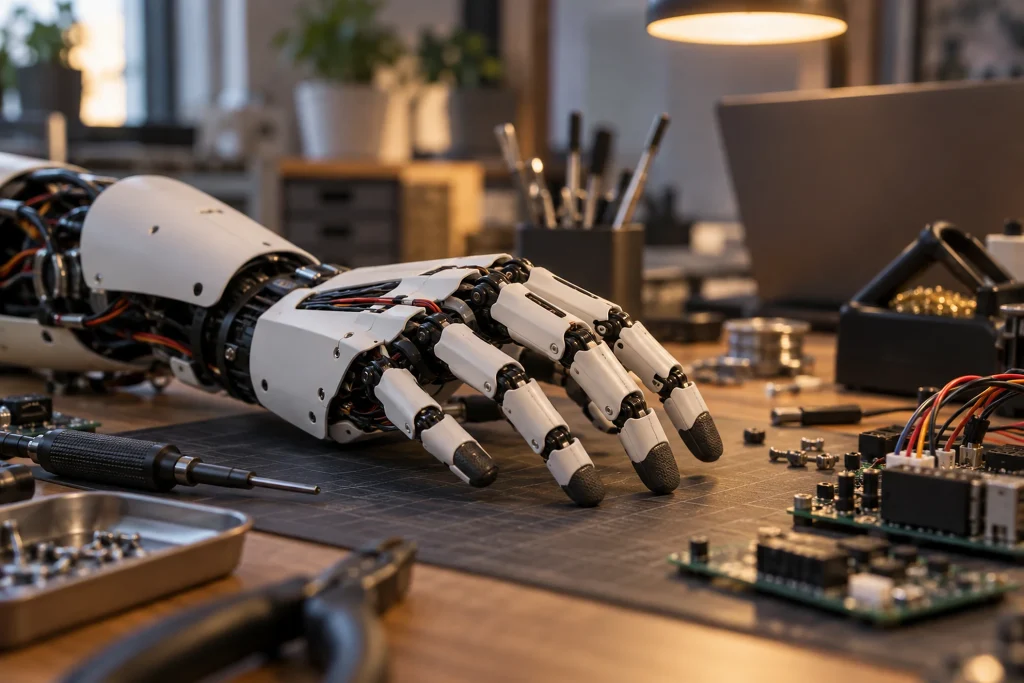
Vittorio Lumare’s low-cost Yeah Hand aims to improve dexterity, a fundamental problem in robotic hands. The hand, which is largely 3D-printed, uses five servo motors that operate with fishing-line tendons transmitting movement instead of actuators in the fingers. To reduce friction and overheating, the tendons are routed through PTFE Bowden tubes; in tests, the hand completed 800 opening-and-closing cycles without overheating. It can lift up to eight kilograms and apply five kg of gripping force. Silicone surfaces enable the grasping of smooth objects, while thumb nails allow small objects to be picked up.
- Robotic version: Includes various mounting flanges and a ROS driver.
- Experimental prosthetic version: The main difference is the mounting method.
The hand can also be controlled with a flexible-sensor glove that detects finger position and mirrors the movement.
Why it matters
The importance of the Yeah Hand lies in addressing the balance between range of motion and manufacturing cost in robotic hands through a more accessible design. The use of tendon-based transmission instead of separate actuators for the servo motors makes the hand a design option that robotic-hand researchers can examine in terms of its control and mechanical arrangement. The mounting options and ROS driver in the robotic version are important for teams assessing its adaptation to different systems. The existence of an experimental prosthetic version shows that the same mechanical approach is also being tested in a context aimed at human use. However, the available information does not provide conclusions about this version’s durability under real-world use conditions, user safety, or adequacy for everyday functions.