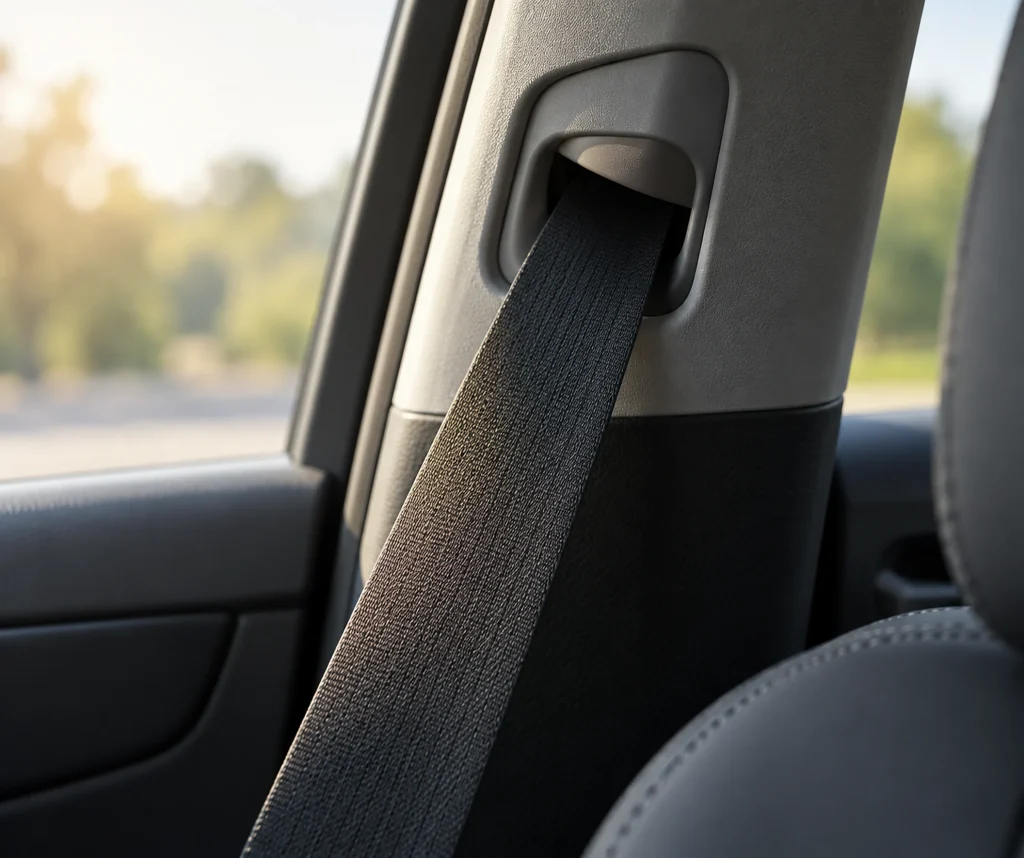
The seat belt should retract into the reel on its own when it is released. If the belt slows down, stops halfway, or does not retract without being guided by hand, there may be friction or a mechanical failure. The main causes include the belt twisting, friction at the upper guide, becoming trapped between the seat and the trim, and the accumulation of sweat, dust, and dirt on the surface. The fabric may stiffen; the spring-loaded reel or retraction system may also fail. In the event of a sudden problem, the trim piece can be checked. Any intervention must not alter the way the mechanism operates.
For cleaning, the belt can be pulled out in a controlled manner and inspected; it should not be pulled forcefully to its end point. Strong chemicals, bleach, and solvents should not be used. The belt must be dried completely and should not be wound onto the reel while wet; moisture may reach the mechanism. It can then be pulled out and released several times to observe its behavior. If there are cuts, severe wear, or fiber damage, a safety assessment is required.
Oil, silicone spray, or any other chemical should not be applied to the belt fabric; the material may be damaged and could attract dirt. Spraying the mechanism or stretching the spring is not safe. In modern systems, the locking mechanism and, in some vehicles, the pyrotechnic pretensioner system may be located in the same area.
Why It Matters
The seat belt’s retraction problem concerns not only user comfort but also whether the belt is in the correct position when needed and whether the protective systems can operate safely. For this reason, users must recognize the boundary between a simple cleaning procedure and interfering with the mechanism; applying lubricants or solvents, or attempting to alter the spring, may damage the material and the system instead of solving the problem. When cuts, noticeable wear, or fiber damage are observed, the issue is no longer a maintenance matter that can be handled at home and requires a safety assessment. Particularly in vehicles equipped with a locking mechanism or a pyrotechnic pretensioner system, the question that remains is whether the problem stems only from surface contamination or from an internal failure requiring expert intervention.