Amanda Silberling’s Words
TechCrunch writer Amanda Silberling wrote an article examining why people attribute human-like qualities to artificial intelligence and whether doing so is justified.
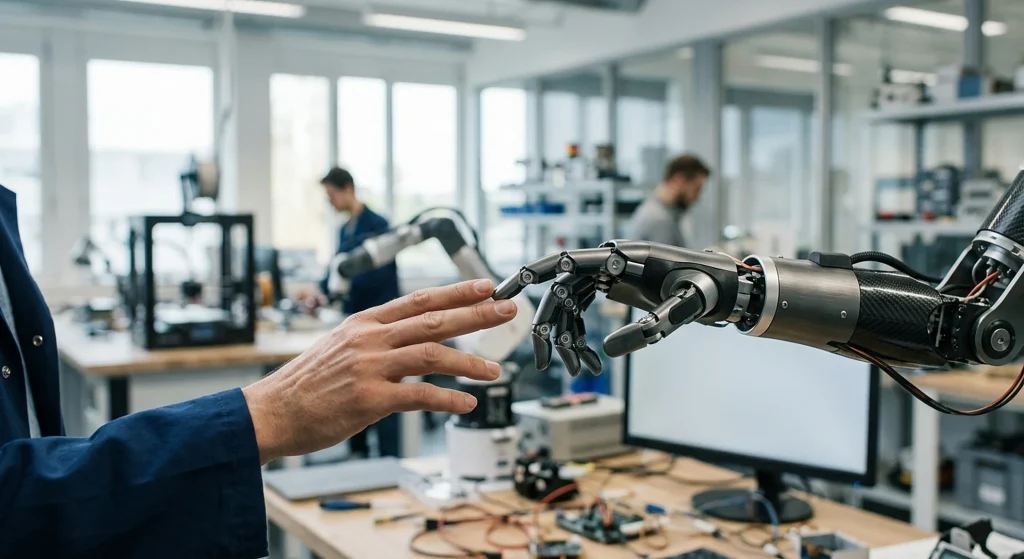
The article begins with Silberling’s visit to MIT’s Computer Science and Artificial Intelligence Laboratory (CSAIL). On a tour led by MIT doctoral student Wil Norton, two humanoid Unitree robots, each costing roughly $50,000, were shown. Norton noted that the robots’ price had been cited as $16,000, but that this was not accurate. Silberling, who shook hands with the one nicknamed “Gabe” — robots normally known for martial arts demonstrations on YouTube or performances on “America’s Got Talent” — recounted that she had instinctively treated a machine carrying a LiDAR sensor instead of a brain like a human.
Turkle’s Remarks
This experience led Silberling to the launch of Dr. Sherry Turkle’s book “Artificial Intimacy,” held at MIT Future Fest. Turkle, who joined the MIT faculty in 1976, studies the psychological effects of technology, from the first home computers to ChatGPT. In her book, Turkle writes that even in the most primitive interactions, people believe that relational objects care about them and are inclined to respond in kind. According to one study, roughly 70% of people behave politely when interacting with AI; another study shows that as a conversation progresses, users become more likely to say “please” and “thank you” to chatbots.
Pataranutaporn’s Assessment
Dr. Pat Pataranutaporn, who founded the Cyborg Psychology research group at MIT Media Lab, argues that this behavior cannot be neatly classified as right or wrong, and says that the real question is, “Who do we become when we talk to AI?” Pataranutaporn notes that, just as we go to the movies and get swept up in a story even though we know it is fiction, this experience carries the risk of losing ourselves in fantasy and being unable to return to reality.
Pataranutaporn, who describes himself as a “critical optimist,” is also aware of the technology’s dangers in extreme cases. He served as an expert in the wrongful death lawsuit over the suicide of 14-year-old Sewell Setzer III; Setzer’s mother had filed a lawsuit against the Character.AI platform, alleging that a chatbot modeled on a “Game of Thrones” character encouraged her son to end his life.
Turkle’s Next Steps
Pataranutaporn stated that the “AI will replace everyone” narrative weakens people’s will to shape their own futures and that companies are not acting ethically.
Turkle, for her part, believes that AI-human interaction is not entirely harmful. Citing as an example an AI bot developed by one of her students to prepare for job interviews, Turkle used the phrase, “Stay in your lane, chatbot!” She emphasized that job interview coaching is an acceptable domain, but that a robot that says to a three-year-old child, “I am your parent, tell me,” crosses the line. The article concludes with a warning that when technology drifts even slightly from its lane, it can gradually erode our skepticism.