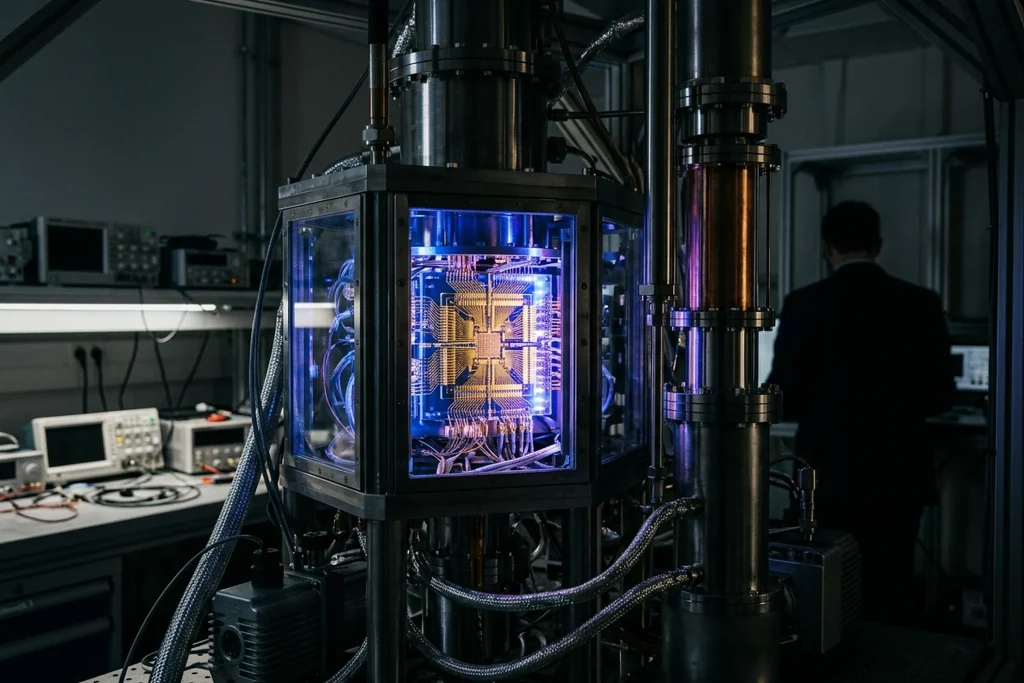
An unusual quantum effect that brings a particle to a complete stop has been recreated by scientists. The experiment was carried out using a hybrid quantum computer. While reproducing the Aharonov-Bohm effect, which demonstrates that a particle can be influenced by a magnetic field without passing through it, Oxford University researchers observed that the invisible magnetic influence brought the simulated particle to a complete halt. The results were published in the journal Nature Physics. In the study, qubits, the fundamental units of quantum information, were combined with quantum oscillators representing vibrational motion to investigate matter-field interactions, which are becoming increasingly difficult to simulate with classical computers.
The effect was predicted in 1959 by physicists Yakir Aharonov and David Bohm. A charged particle could experience a measurable change in its quantum phase even if it passed entirely outside the region containing the magnetic flux. The phase itself cannot be observed directly. Nevertheless, phase differences produce measurable effects, and this prediction was later confirmed in experiments conducted with real electrons.
This time, the focus was on lattice gauge theories. Researchers are examining the same phenomenon in these theories, which describe how matter interacts with fields associated with the fundamental forces. Here, space is represented like a grid. Matter resides at the points, while fields occupy the links between these points. The mathematics of these models, which are important in particle and high-energy physics, challenge even powerful classical computers as the systems grow more complex. Quantum simulation, by contrast, relies on building another quantum system that follows the same fundamental rules and directly observing its behavior.
The project began in 2022. The lead author of the study is Dr. Sebastian Saner, working in collaboration with Dr. Oana Bazavan and Dr. Alejandro Bermudez of the Instituto de Física Teórica in Madrid. The experiment used two components. Qubits encoded in the internal states of charged atoms held in place by electromagnetic fields represented the gauge fields, while oscillators formed from the vibrations of the same ions represented matter. Two oscillators represented matter at two sites, and two qubits represented the fields connecting these sites, forming a simple ring.
The team encoded the flux into the qubits. The two qubits were placed into an entangled quantum state representing the magnetic flux passing through the center of the ring. The original plan was different. The intention had been to add the flux as a fixed background condition, but the hardware used was not suited to implementing this approach directly. Encoding the flux into the qubits offered a practical alternative and made the flux part of the evolving system. “The exciting step for us was encoding the magnetic flux into a gauge field that is itself dynamic,” says Dr. Saner.
The simulation tested tunneling. In the absence of magnetic flux, the particle could tunnel freely around the ring. When the flux was added, the relative phases of the two possible paths changed, the paths canceled each other out through destructive interference, and tunneling was completely suppressed. The particle froze in its initial state. As a result, the Aharonov-Bohm effect was demonstrated in a lattice gauge theory involving a dynamic field.
The findings were published together. A University of Maryland team led by Professor Norbert Linke also carried out a related study simulating the Yukawa potential. The two groups developed their methods independently. However, they submitted their papers to Nature Physics in a coordinated manner.
Why it matters
This experiment demonstrates with a concrete example that quantum computers can be applied to physics problems that classical machines struggle to handle. Since lattice gauge theories, which are fundamental models of particle and high-energy physics, exceed even the most powerful classical computers as the system becomes more complex, the hybrid simulator offers an alternative route around this bottleneck. The fact that the design combining qubits and oscillators in the same hardware emerged, moreover, from an unplanned hardware constraint indicates that more complex systems can be represented with limited resources. The simultaneous publication in the same journal of studies developed by two independent teams using different methods supports that the finding is not specific to a single laboratory. The question that remains open is whether this approach can be extended to larger-scale and more realistic physical systems.