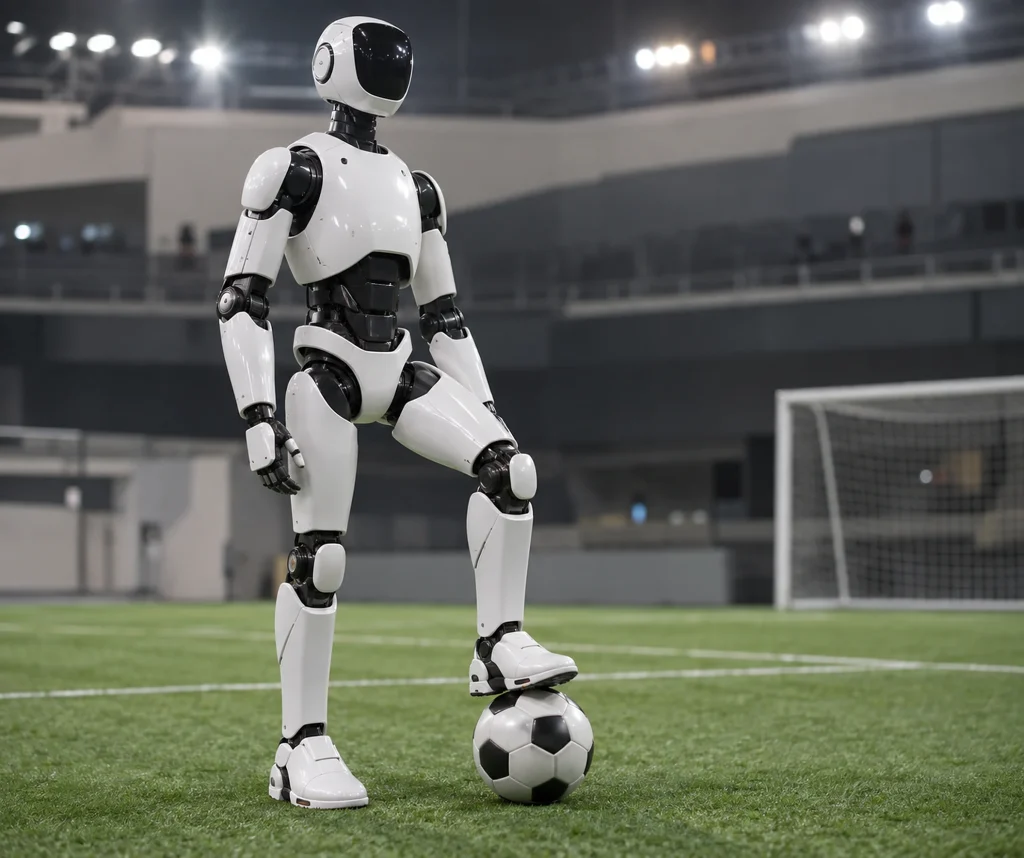
Skild AI announced that, in a new demonstration of its soccer-playing humanoid robot, it trained the model by having it play matches against its own versions in NVIDIA Isaac Sim, rather than programming each movement individually. The primary objective over approximately 140 years of simulated gameplay was to score goals; skills such as dribbling, blocking an opponent’s path and getting back up after falling developed in pursuit of this objective. This does not mean that the robot trained for 140 years in the real world.
The transfer of behaviors learned in simulation to the physical robot was a highlight of the demonstration. The company said it did not define separate rewards for shielding the ball and challenging for possession, and that these strategies emerged because they increased the chances of scoring. However, there is no independent measurement of how performance on a real field would change under different ground, ball, opponent and contact conditions.
Why it matters
This approach highlights the idea that, rather than every movement being defined in advance in robotics software, behaviors can emerge around a more general objective. For this reason, the development raises the question of how simulation training should be designed, particularly for researchers interested in humanoid robots making decisions in complex and changing environments. The ability to transfer learned behaviors to a physical robot also shows that the gap between simulation and the real world is not merely a technical detail; changes in the ground, the ball and contact with opponents can affect the results. The key unresolved issue is the extent to which the skills demonstrated will be preserved under different real-field conditions and how this transfer will be validated through independent measurements.