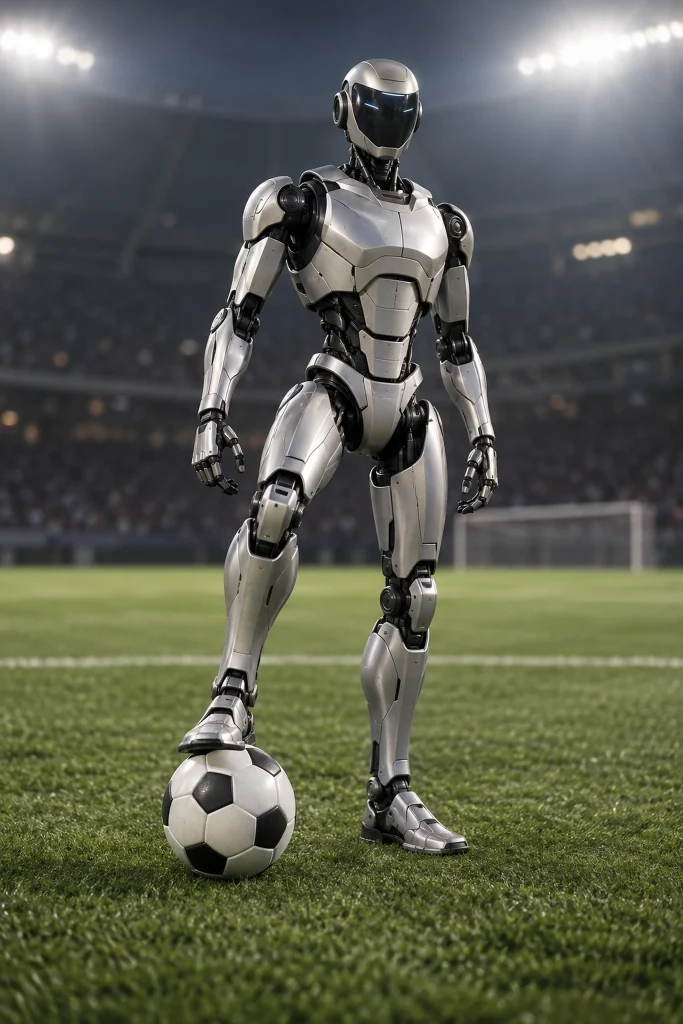
The robotics artificial intelligence company Skild AI built a field in its S1 system where it could learn football on its own, rather than coding the sport one move at a time. In NVIDIA’s Isaac Sim virtual environment, the system played matches equivalent to 140 years of football experience, with the sole aim of scoring goals. It developed skills such as approaching and dribbling the ball and blocking the opponent during the matches. The robot, which initially struggled to walk, was given the name “Messinator.”
In training, the opponent and teacher were earlier versions of the robot. Through self-play, it retained the moves that worked in increasingly difficult matches. After virtual training, it tested its abilities to dribble, change direction and block the opponent on a real surface. The robot also tracked the opponent’s movement and decided on its next move while maintaining its balance and controlling the ball. Skild AI aims to use this method for tasks in factories, construction sites and homes.
Why it matters
This approach highlights the idea of teaching robots skills through goals and trial and error, rather than describing every movement separately. The ability to test behaviors developed in a virtual environment on a real surface separates the learning process from trials on a physical robot and offers a method that could be used for tasks in factories, construction sites and homes. However, it is not yet clear to what extent the balance, direction-changing and blocking skills that work in football will apply to different tasks. For this reason, the development raises the question—particularly for those interested in robots making decisions under changing conditions—of whether the learning method, rather than a single skill, can be transferred to other fields.