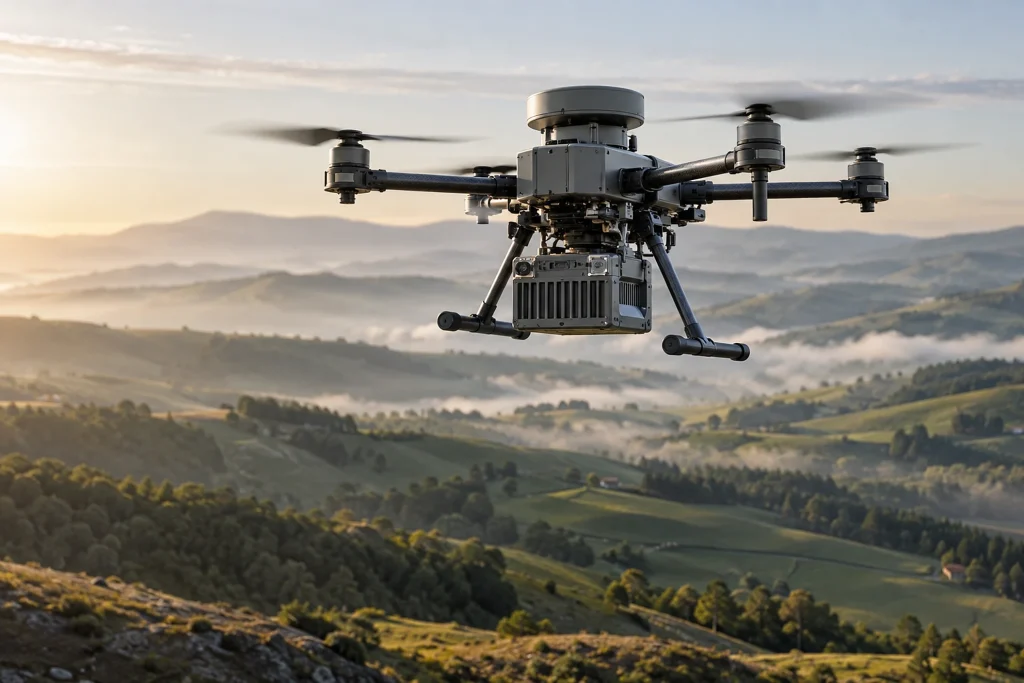
Henrik Forstén improved the system more than a year after the first version of his synthetic aperture radar (SAR) imaging drone. He wrote a more powerful autofocus algorithm to clean up radar images and added high-resolution interferometric imaging. The first system’s GPS resolution of approximately one meter was improved through position estimation. While expensive RTK GPS provides accuracy of a few centimeters using a correction signal from a fixed station, post-flight PPK achieves similar accuracy. In the hardware, the phase-locked loop that generates the frequency sweep was stabilized, and compression was developed for the FPGA’s slow SD card interface. The drone flies the same route twice at different altitudes to create an elevation map. Comparing the phases from the two passes resolves the problem of vertical objects appearing tilted toward the radar. Bicycle-based, budget SAR systems and a setup guide had also been covered previously.
Why it matters
These updates move the system beyond being merely a platform that collects radar data, bringing it closer to a measurement tool capable of processing the data with more precise position and elevation information. The ability to achieve positional accuracy with post-flight PPK rather than expensive RTK GPS offers an option that could affect hardware and infrastructure choices for fieldwork. Because interferometric imaging relies on scanning the same area from different altitudes, it has the potential to reduce the geometric ambiguity that vertical structures create in radar images. However, how much this method, which requires two flights and post-flight data processing, complicates the workflow and how the resulting elevation maps will be validated remain open questions.