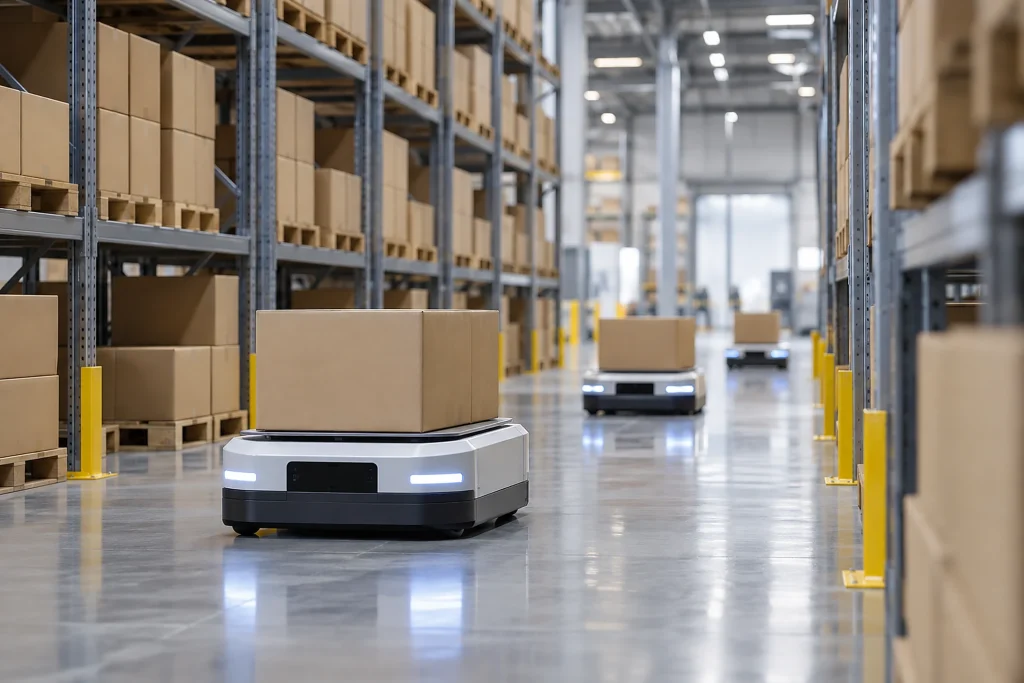
After being founded in 2024, Maven Robotics won a logistics contract from a major consumer products company, beating out competitors that already had robots in place. CEO and co-founder Hamza Derbas said that, rather than talking about robot vision, they developed their end-to-end automation systems by examining the company’s factories and warehouses. After two years of work, Maven was reported to have reached eight robots operating 16 hours a day and uptime of 99% or higher at some of its customers.
The startup emerged from stealth with a $100 million investment from RoboStrategy, LocalGlobe, Vine Ventures and XTX Ventures. The company plans to produce 250 third-generation robots and begin designing its fourth-generation platform. The robots, which have wheeled bases, can travel at 10 miles per hour and carry two arms capable of lifting up to 30 kilograms. Their primary task is to turn boxed products arriving from different factories at distribution centers into new mixed pallets tailored to store demand. This process is currently carried out by human labor.
At Maven’s facility in Santa Clara, robots use vacuum grippers to pick up and arrange boxes. The company’s CEO has worked in automotive engineering and electric vehicles; before Maven, he spent nine years in Apple’s special projects group. He founded Maven in 2024 with his brother Khalid Derbas, who became the company’s CFO. The firm draws on engineers experienced in self-driving vehicle projects to train its autonomous hardware using real-world data. It is building a system that receives data from operational robots within minutes or hours and repeats the processes of retraining, evaluation and redeployment.
According to investor Jack Pearson, what differentiates Maven is its focus on industrial systems rather than on a specific robot architecture. Derbas said he respects Agility, which develops bipedal robots and is expected to go public this fall through a $2.5 billion SPAC deal, but argued that this design is unsuitable for industrial work because of its complexity and cost. While the palletizing market is said to be worth $80 billion, Maven aims to expand into material handling, automation and manufacturing for new tasks. Although the company is pursuing a general-purpose robot, it is basing its strategy on solving individual customer problems. Derbas said they are focused not on a race between models, but on automating industrial labor on a global scale.
Why it matters
Maven’s approach shows that in robotics investments, hardware is being evaluated not on its own but together with the existing workflows of factories and warehouses. This is particularly relevant to logistics and manufacturing companies that still rely on human labor for operations such as converting boxes into mixed pallets, because the solution is based on an end-to-end system that can be deployed across different facilities rather than on robots that perform a single task. The investment could allow the company to transfer the data it has obtained from a limited number of operational robots into a broader production and retraining cycle. However, the open question is to what extent this model, shaped around customer problems, will align with the goal of a general-purpose robot while maintaining the same level of uptime across different tasks and facilities.