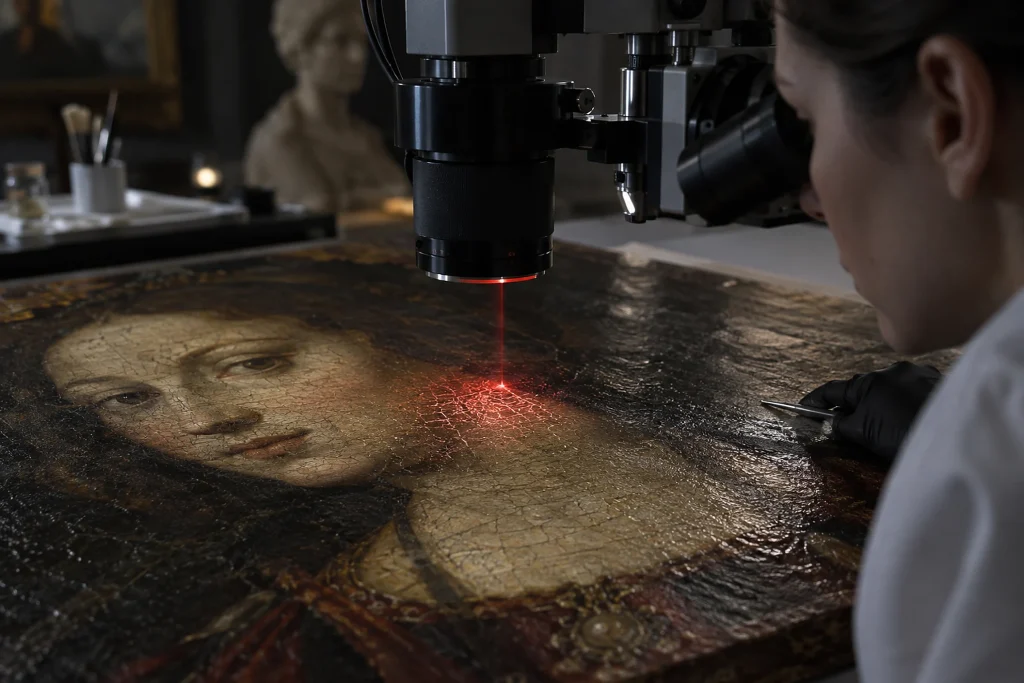
Researchers at Uppsala University examined the pigments in a painting depicting Roman Emperor Domitian that is thought to possibly be by Leonardo da Vinci, using laser-based Raman spectroscopy, microscopy and X-rays. The work was offered for sale by Christie’s in 1928 and 1929 and attributed to Titian. An “L daVinci” signature, visible only when illuminated from the correct angle because of its low contrast, was later found, along with a word thought to be “pinxit,” Latin for “painted.”
The study, published in Materials Today Advances, identified a total of 13 pigments. Of these, 12 were traditional materials used in the Middle Ages or the Renaissance, while the pigment in the signature was carbon black, known since antiquity. However, Prussian blue, which was not produced before the early 18th century, was also detected. The researchers said it may have been added during a later restoration or retouching; X-ray images showed signs of alteration in one of the relevant areas.
Jakob Thyr said the newer pigments did not prove forgery and that material analysis could not definitively identify the painter. The study demonstrated that analytical methods could be applied to artworks and archaeological finds. Thyr also said he believed such examinations would become widespread in the future.
Why it matters
The painting’s past attribution to Titian shows that the signature discovered later is not sufficient on its own to establish a connection to Leonardo da Vinci and that the attribution must be tested against different types of evidence. While the fact that most of the pigments are consistent with the period does not rule out this possibility, the presence of Prussian blue makes it necessary to distinguish the work’s production date from later interventions. Separating restoration materials from the original layers reveals the context that analytical methods can provide in dating artworks and archaeological finds. The combined use of laser-based analysis, microscopy and X-ray imaging allows different layers and alterations to be assessed through physical evidence. The main unanswered question is whether the signature and period-appropriate pigments genuinely indicate Leonardo’s hand; the current analysis does not definitively identify the painter.