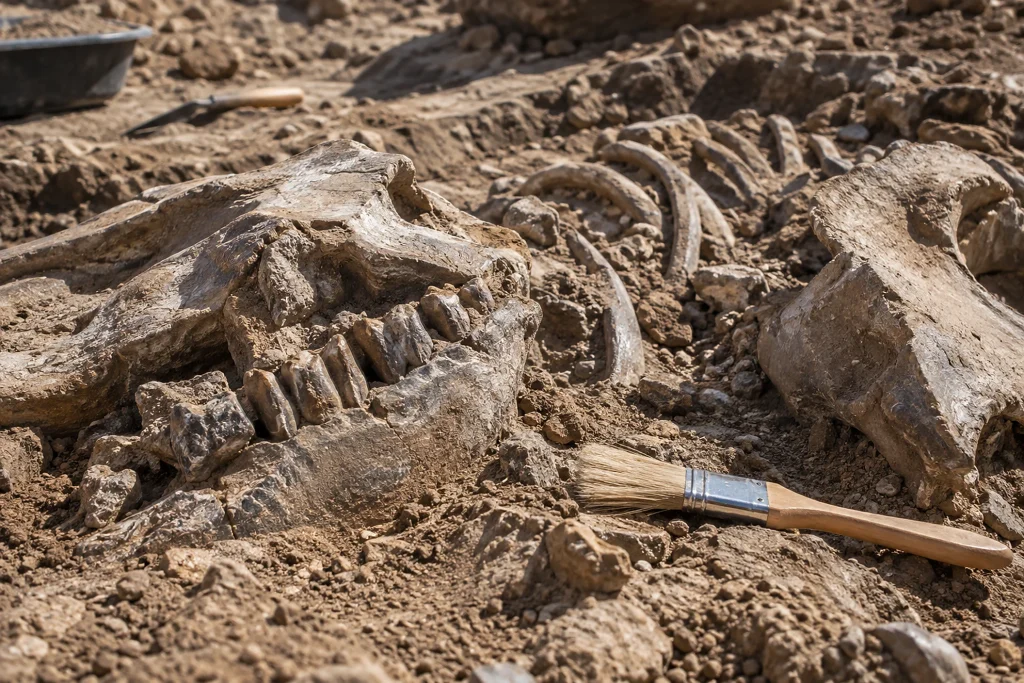
Teams working on an infrastructure project in Oceanside, California, found the bones of a large mammal that lived 40 million years ago in the Santiago Formation, at a depth of approximately 3.5 meters, during routine monitoring. Paleontologist Dr. Joseph El Adli said the finds included ribs, a femur, and limb bones. The fossils were said to possibly belong to a brontothere, an elephant-sized animal that generally had a Y-shaped nasal horn, or to a hornless, hippopotamus-shaped amynodont. Amynodonts had tusks instead of canine teeth. Both species belonged to the order Perissodactyla. The fossils are estimated to be 40 to 45 million years old and to date to the Uintan North American Land Mammal Age. After being left exposed for one week, the bones were placed in plaster casts and transported to a temperature-controlled laboratory; they will be examined and sent to a museum. Several blocks are being kept closed to traffic while a skull is sought to establish the exact identity.
Why it matters
The scientific significance of the find lies not only in the discovery of ancient bones, but also in the possibility that it may provide new evidence of the diversity of the order Perissodactyla during the Uintan North American Land Mammal Age. However, the fragments currently available are insufficient to determine whether the fossil belonged to an elephant-sized, horned brontothere or a hippopotamus-shaped amynodont; this distinction could change assessments of the animal’s way of life and evolutionary position. For this reason, the skull being sought is the most critical piece for answering the central open question surrounding the discovery. Laboratory examination followed by its transfer to a museum will ensure that the find does not remain merely a discovery in the field, but becomes part of the scientific record and a publicly accessible collection.
Background
California is not a new name in the FikirPilot archive: in the last 90 days, we published a news article mentioning this name; that article is dated September 11, 2026.