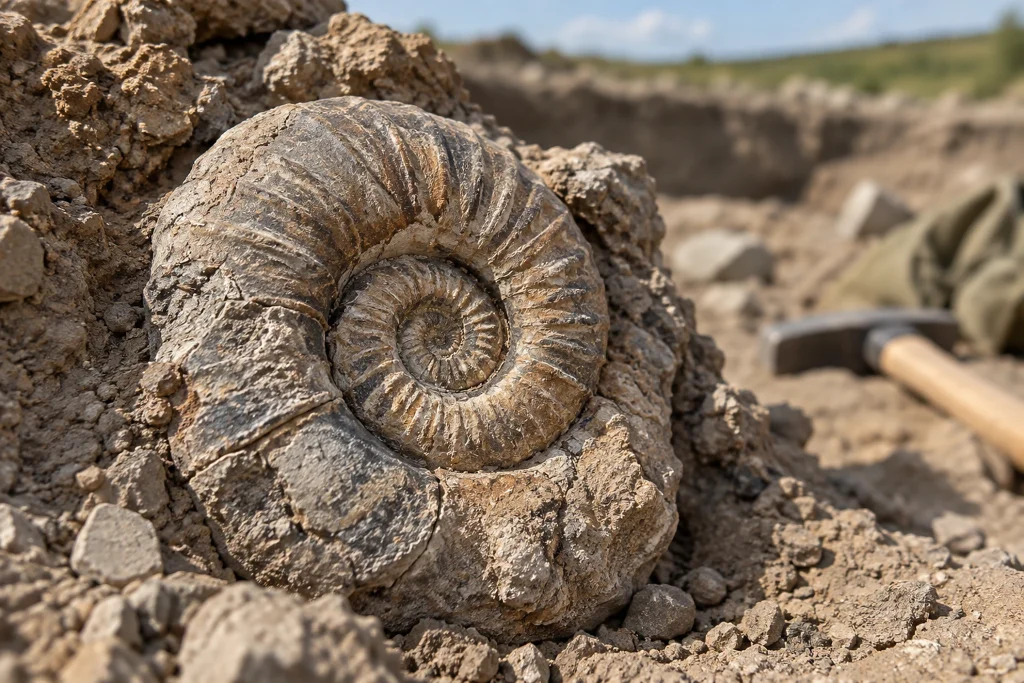
Minister of Culture and Tourism Mehmet Nuri Ersoy announced that a Gastropoda fossil that lived on the shores of the Tethys Sea 66 million years ago had been found during excavations at Külhöyük in Oyaca, in Ankara’s Gölbaşı district. The fossil is thought to date from the final stages of the Tethys Sea, which also covered Central Anatolia. The fossil found at Külhöyük, a 5 thousand-year-old Hatti and Hittite city, is believed to have possibly been brought there by the settlement’s inhabitants thousands of years ago. Since 2021, the excavations have been carried out under Presidential Decision Excavation status on behalf of the Ministry and Ankara University, under the direction of Associate Professor Derya Yılmaz Tekin. Ersoy said the discovery shed light on Ankara’s natural history spanning millions of years. Külhöyük had also yielded the oldest known seed remains of Sevgi Çiçeği, found in a 4 thousand-year-old Hittite vessel.
Why it matters
The finding at Külhöyük shows that the area’s geological past and the history of human settlement can be read together. The possibility that the fossil was transported by the settlement’s inhabitants raises the question of how people in the Hatti and Hittite periods perceived and used the natural remains around them. For this reason, the discovery’s significance lies not only in the fossil’s age but also in investigating the process by which it arrived at an archaeological site. The continuation of the excavations under Presidential Decision Excavation status, together with the previous discovery at the site of the oldest known seed remains of Sevgi Çiçeği, shows that Külhöyük brings together natural and cultural traces from different periods within the same study.
Background
Ankara is not a new name in the FikirPilot archive: we have published 2 stories mentioning the name in the past 90 days; the latest was dated September 7, 2026.