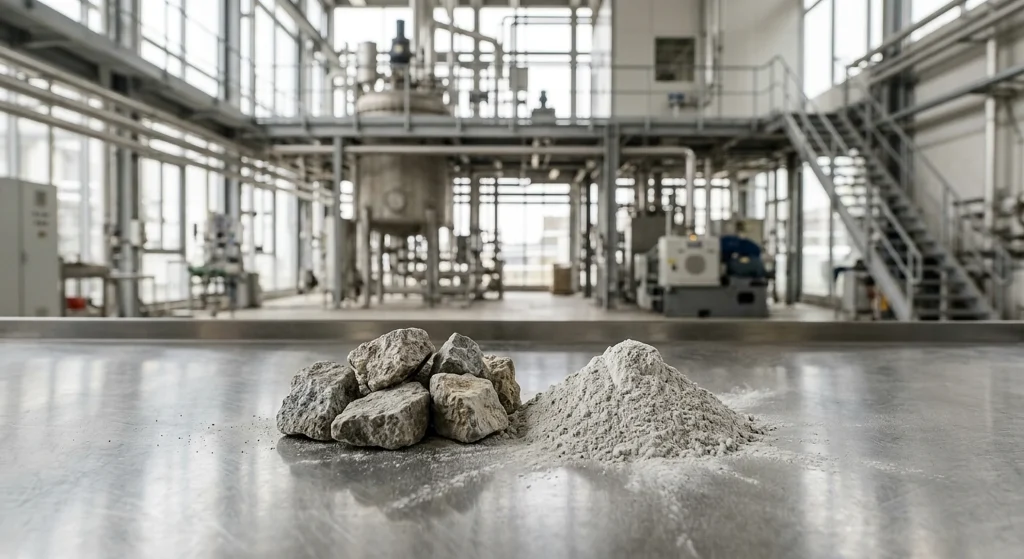
US-based startup Brimstone is seeking to solve two industrial problems in a single facility by aiming to both reduce emissions in cement production and produce critical minerals domestically.
Founded in 2019 and headquartered in Oakland, California, the company reduces greenhouse gas emissions from cement production by approximately 60% by using silicate rocks instead of standard limestone. Traditional cement production is responsible for approximately 8% of the world’s carbon dioxide pollution. The company, which highlighted this climate benefit during the Biden era, is under the Trump administration emphasizing its capacity to extract valuable materials from the same rocks.
Brimstone, which announced in early 2025 that it could produce smelter-grade alumina, the raw material for aluminum, revealed at the end of last year that it could produce steel, magnesium, titanium, and other critical minerals from the same rock in a single refinery. CEO Cody Finke says the global market for these materials is $2.4 trillion and that the company will offer a domestic alternative to products currently produced mostly in China. The company received third-party industry certification for its Portland cement process in 2023.
However, Brimstone has not yet produced at commercial scale. The Trump administration canceled the $189 million grant intended for the planned facility in Reno, Nevada. Finke says talks are ongoing to recover the funds.
Why it matters
Because cement production is responsible for approximately 8 percent of global carbon emissions, every technological reduction in this field amounts to a major lever for climate policy on its own. By extracting cement as well as alumina, magnesium, and titanium from the same rock, Brimstone’s process combines the climate agenda with the goal of reducing dependence on China in a single investment; this positions the company at the intersection of both environmental and supply-security debates. The company’s emphasis on climate benefits under the Biden administration and on critical minerals under the Trump administration shows that clean-tech ventures are forced to repackage themselves with the political winds. However, the cancellation of the $189 million grant demonstrates that this positioning was not enough to protect federal support, and it serves as a reminder of the fragility of public financing for similar projects. Even though certification has been obtained, commercial production has yet to begin, leaving open the questions of whether the method will work at industrial scale and whether the company will be able to secure new financing.