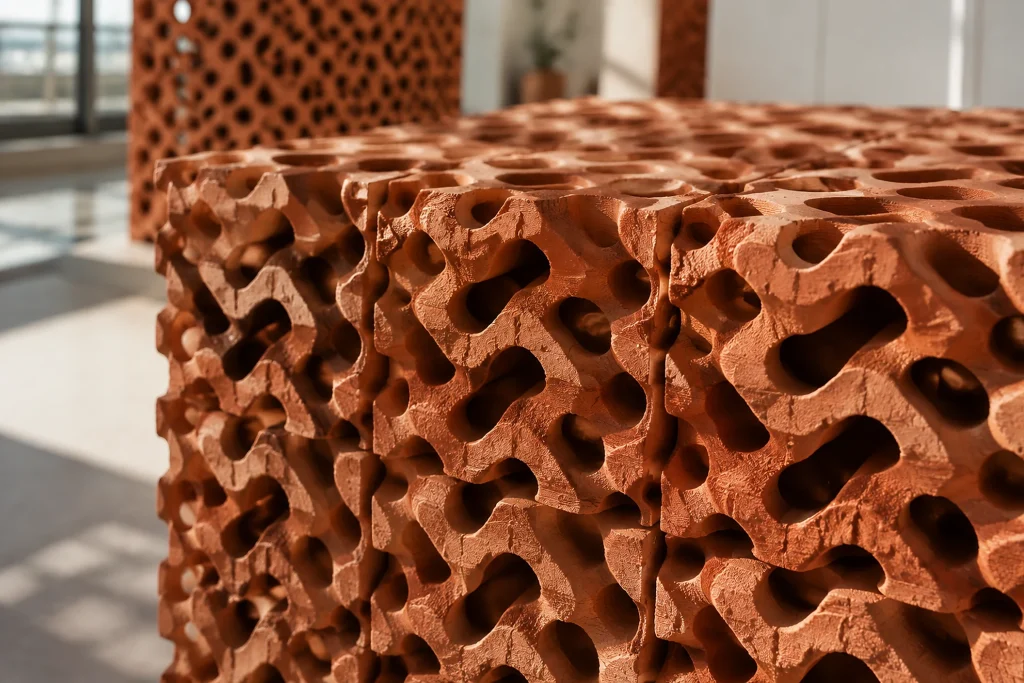
Passive evaporative cooling, used for centuries, lowers temperatures by drawing heat away as water evaporates. Graz University of Technology in Austria has developed 3D-printed cubes that cool the surrounding air as long as they are kept wet. The prototype wall, made from a special clay mixture, increases the water’s contact with airflow in two ways. A porous gyroid pattern that can be printed without support and contains no enclosed sections or dead ends increases the surface area. A bio-inspired mixture of clay, fungal mycelium and wood particles is fired at a low temperature; when the organic matter burns away, fibrous capillaries and larger voids remain. This creates a ceramic structure with a large evaporation surface relative to its size. In a test in a hot attic, the air near the water-saturated cube was measured to be nearly 7°C lower.
Why it matters
Because this approach bases cooling on the material’s porous structure and the evaporation of water rather than on a mechanical system, it offers a different design option, particularly for cooling hot indoor spaces. The cube’s effect relies on the capillary structure formed by the clay, fungal mycelium and wood particles working together with the gyroid pattern; this shows that performance depends not only on the material used but also on the way it is produced. However, since the measurement was based on a single test condition in a hot attic, the question of how the result would change in different environments and over different periods of use remains open. How much water the system requires and whether it can be implemented across large areas are also among the factors that will determine the idea’s practical value.