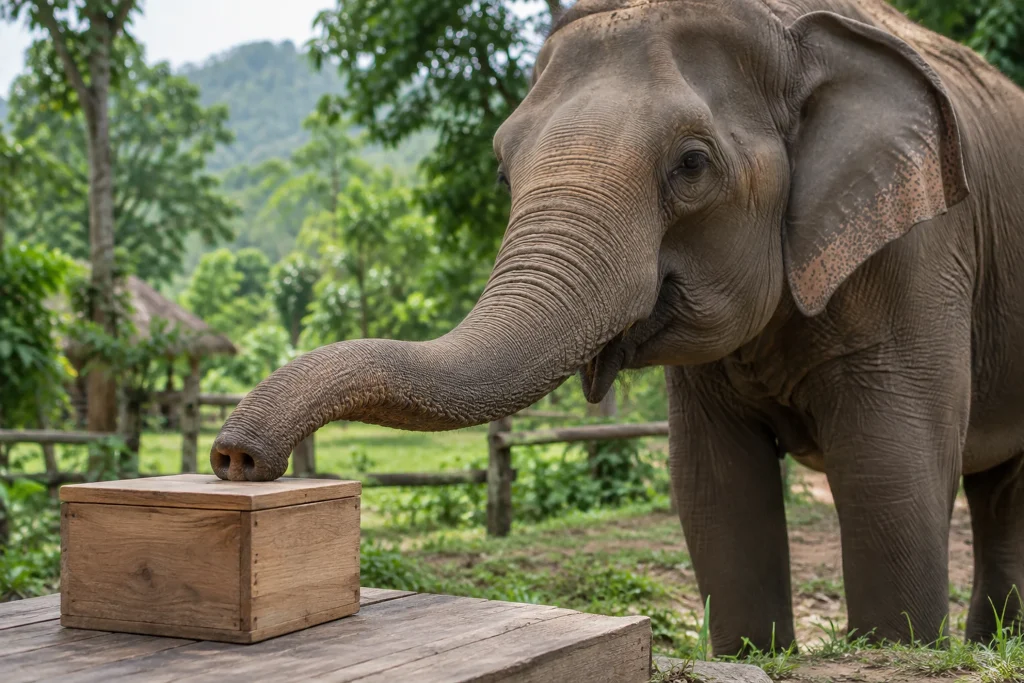
Researchers determined that Asian elephants can suppress ineffective impulses and choose more effective solutions, indicating inhibitory control abilities. The study, conducted at Thailand’s National Elephant Institute and published in the peer-reviewed PLOS One, involved 16 elephants. The elephants learned to reach food in a box through a single opening. They later used the side opening instead of reaching directly in a transparent box where they could see and smell the food. When the box was rotated, they initially moved toward the former opening position, but soon changed their behavior and adopted the new route. Older elephants made this change more slowly; researchers linked this to age-related cognitive decline. Scientists stated that the study provided some of the first evidence of the presence of inhibitory control in elephants, but that further research was needed. It was noted that this ability could be important in problem-solving and socialization, and could also contribute to strategies for preventing human-elephant conflicts.
Why it matters
These findings provide new ground for evaluating elephants’ capacity to change their behavior in terms of cognitive functioning and aging. In particular, the slower adaptation shown by older individuals requires the relationship between cognitive decline and behavioral flexibility in elephants to be examined further; this also raises the issue of the role of age in problem-solving processes. If the connection between inhibitory control, problem-solving and socialization is confirmed, this information could benefit not only studies aimed at understanding behavior but also approaches designed to reduce human-elephant conflicts. However, preliminary evidence from a controlled experiment involving 16 elephants leaves open questions about the extent to which the ability can be generalized across different conditions and social contexts, as well as how the age-related difference should be explained.