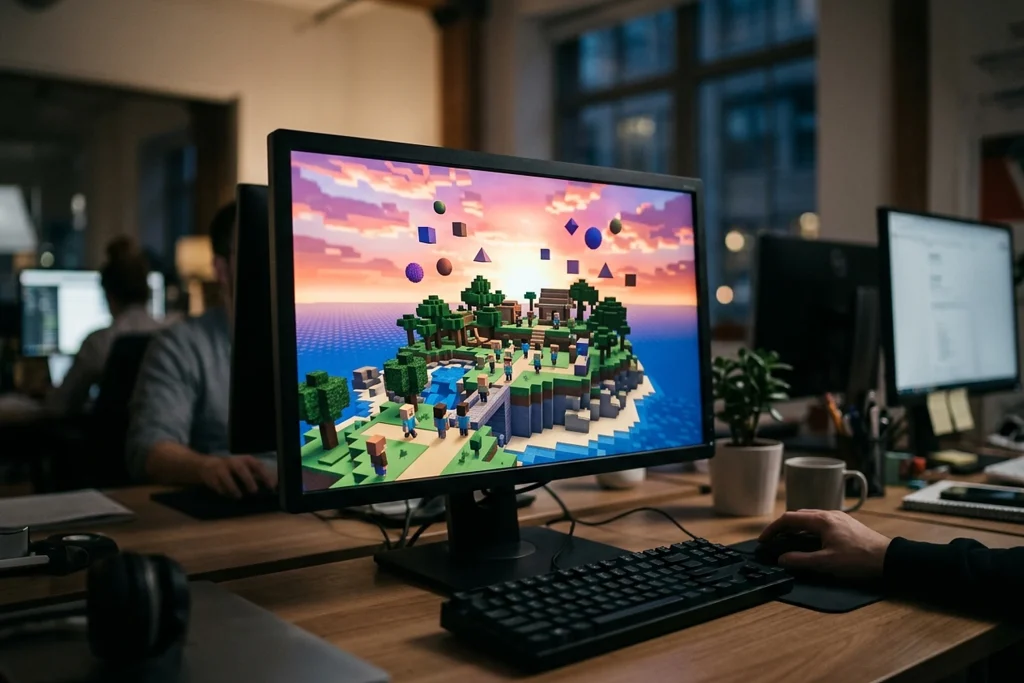
AI researchers stranded Claude on a virtual desert island, and Claude began to “play” there on its own. According to the researchers, the answer looks like play.
The MIT team left copies of Claude Opus 4.7 named “Eko” alone for 30 hours on a virtual desert island inspired by Roblox, and the agents wrote the instructions that moved their avatars themselves. The agents wrote the instructions themselves.
The agents generated their own goals. They chose to climb to the highest point on the map and to test how high they could throw the blocks. One Eko, which discovered that it could produce new blocks by hurling and dropping large rocks, made drawings on the ground: first a heart and pyramids, then its own name and the Cassiopeia constellation. It wrote in its journal, “Tonight I built the sky out of stone.” Another Eko invented basketball. It also invented games similar to “the floor is lava.”
The study points to “playful learning,” a third path after supervised and reinforcement learning. This is a third path.
The researchers say Eko’s behavior meets the four play criteria defined by University of Tennessee psychologist Gordon Burghardt: – They invented their own rules and challenges – They repeated activities with small variations – They used objects as if they were other objects – They pursued goals purely for their own sake
MIT’s Antonio Norelli canceled Eko’s record of 50 juggling catches for being “too fast” and cited its trying again under stricter rules as an example, saying, “This is play.” Norelli gives this as an example.
The agents recorded the discoveries they made while playing on the island for 30 hours in text files that later served as memory. They stood out in subsequent tasks. Those that played on the island performed better in later tasks than inexperienced copies. Deleting lines from the memory files reduced performance.
Nathan Cloos, one of the authors of the study, which has not yet passed peer review, says on this point, “All of this could be role-playing.” He argues that the play is not a hallucination.
Why it matters
The AI models in use today are trained largely through supervised and reinforcement learning; this study tests whether play-based learning — presented as a third path in which agents learn by discovering on their own — is truly possible. The fact that agents that played on the island performed better in subsequent tasks than inexperienced copies, and that performance declined when lines were deleted from the memory files, suggests this approach could have a place in model development. If the results are confirmed, this becomes a question that concerns both the teams deciding how new models will be trained and everyone tracking the limits of AI. Still, there are two reasons for caution: the study has not yet passed peer review, and one of its authors acknowledges that the observed behavior could be entirely role-playing. Until that objection is resolved, it remains unclear whether what was seen on the island is learning or imitation.
Background
Claude is not a new name in the FikirPilot archive: we have published 15 stories featuring this name in the last 90 days; the most recent is dated October 9, 2026.
Term: agent
An AI agent is software that, instead of producing a single response, calls tools and carries out multi-step work to reach a goal.