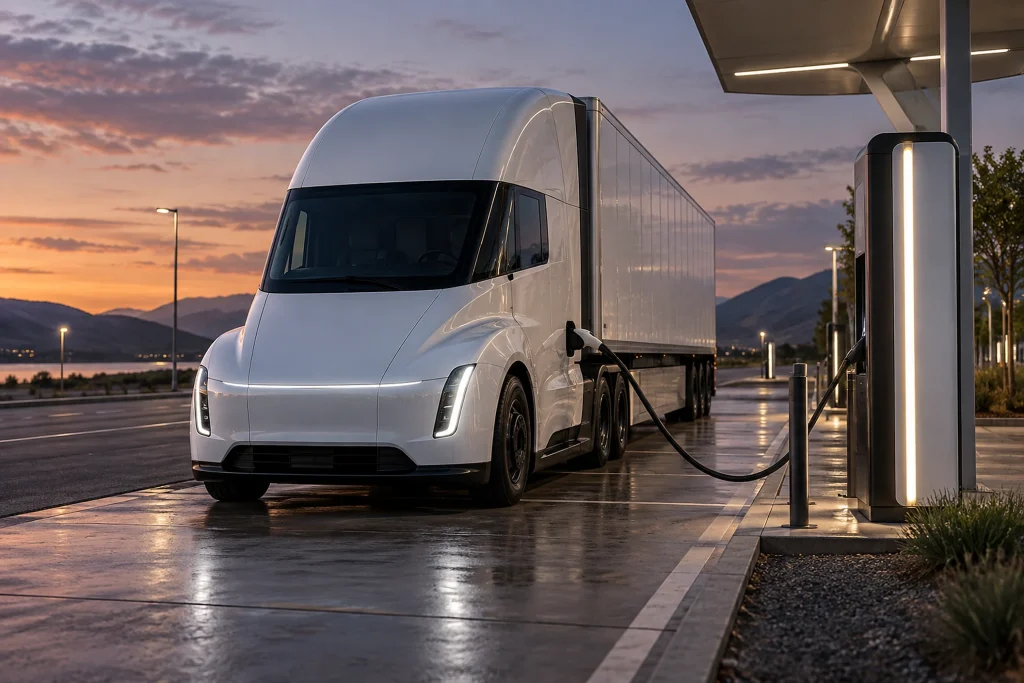
Tesla unveiled the European configuration of its fully electric heavy-duty Semi truck at the IAA Transportation trade fair in Hannover; deliveries will begin in 2027. First announced in 2016, the model made its first customer deliveries in 2022 following delays. Featuring a futuristic interior that positions the driver in the center of the cockpit, the vehicle produces 1,100 horsepower from three electric motors on the rear axle and accelerates from 0 to 100 km/h in 5 seconds without a trailer. With a curb weight of 9.1 tons and a payload capacity of 40 tons, the Semi’s 548 kWh battery provides a range of up to 550 kilometers with consumption of 1 kWh/km. 1.2 MW Megacharging charges the battery to 60% in 30 minutes. While emphasizing the cost advantage, Tesla plans to produce 50,000 units annually at Giga Nevada.
Why it matters
This development raises the question of how the electric tractor unit can be adapted to daily operations for heavy transport fleets in Europe in terms of range, charging time and payload capacity. Support for 1.2 MW charging means that, for businesses considering the vehicle, access to suitable charging infrastructure is becoming as decisive as the choice of vehicle itself. Tesla’s claim of a cost advantage cannot be assessed based on the available data because the sale price, energy costs and consumption under real-world operating conditions are unknown. The model’s previous delays due to setbacks mean that the 2027 delivery schedule and the annual production target of 50 thousand units in Nevada will need to be monitored together. The central driving position and European configuration also represent a separate consideration regarding operating arrangements for fleet operators and drivers.
Background
Tesla is not a new name in the FikirPilot archive: over the past 90 days, we have published 14 news articles mentioning the name; the most recent is dated September 15, 2026.