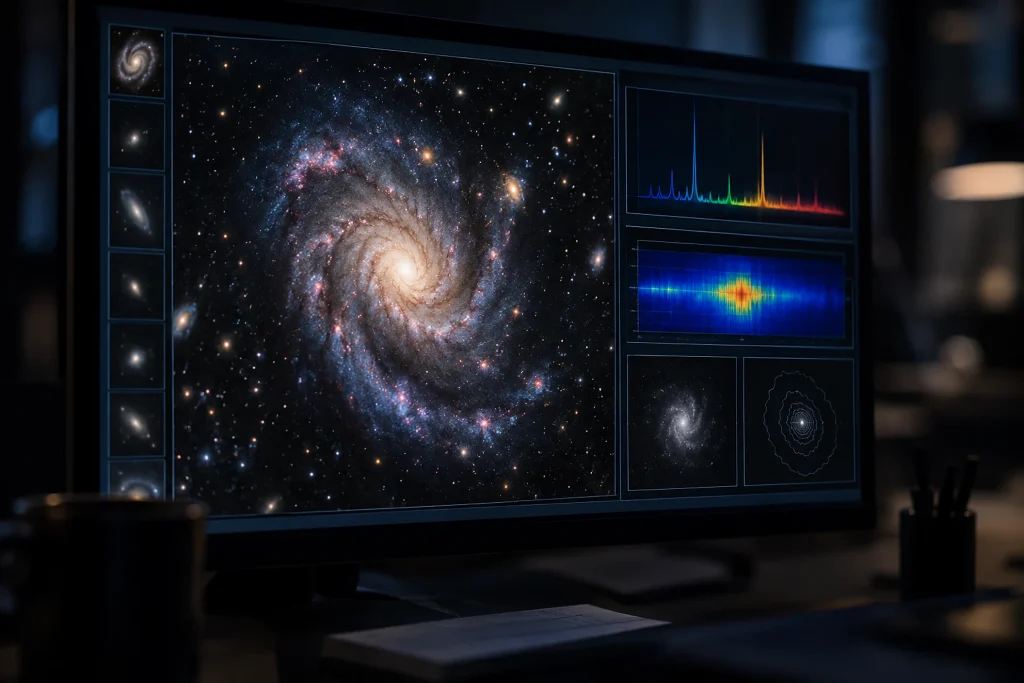
NASA’s new Artifact InSPECtor project is calling on volunteers of all ages to help identify errors in space telescope data and improve artificial intelligence’s ability to recognize them. Participants will examine real telescope data to learn which signals belong to astronomical objects and which are data errors.
The Euclid space telescope, developed by ESA (European Space Agency) with major contributions from NASA, is collecting light from millions of distant galaxies. When it begins scientific observations, NASA’s Nancy Grace Roman Space Telescope will also study a similar number of galaxies at different distances and sky densities. The two telescopes will contribute to answering questions about the expansion of the universe and dark energy, which drives this expansion.
Spectrographs on the telescopes separate light from galaxies into spectra, or sequences of colors. From these spectra, scientists can determine the distances of galaxies, the types of stars they contain, and information about the supermassive black holes at their centers. However, the data can contain “artifacts” that do not originate from actual celestial objects. These can result from causes such as reflections of light within the telescope body, cosmic rays, and camera or electronic problems.
Artificial intelligence is learning to filter out these signals, but it cannot always distinguish them accurately in data from new instruments. Volunteers’ work will be used to improve the instructions that guide artificial intelligence. Beginning in early 2027, the project will also include data from the Nancy Grace Roman Space Telescope. To participate: https://go.nasa.gov/3Uyrguy.
Why it matters
The project shows why human oversight is still necessary in the large datasets obtained from space telescopes. Misclassifying an artificial signal as a real celestial object, or vice versa, can affect the reliability of measurements such as the distance of galaxies and stellar properties; the issue therefore concerns not only the development of artificial intelligence but also the quality of data used in cosmological research. Volunteers’ contributions are intended to help artificial intelligence recognize different types of errors while reducing the burden on scientists of examining every piece of data individually. The question that remains open is to what extent these contributions will produce consistent results in data collected under the different observing conditions of the Euclid and Nancy Grace Roman telescopes.