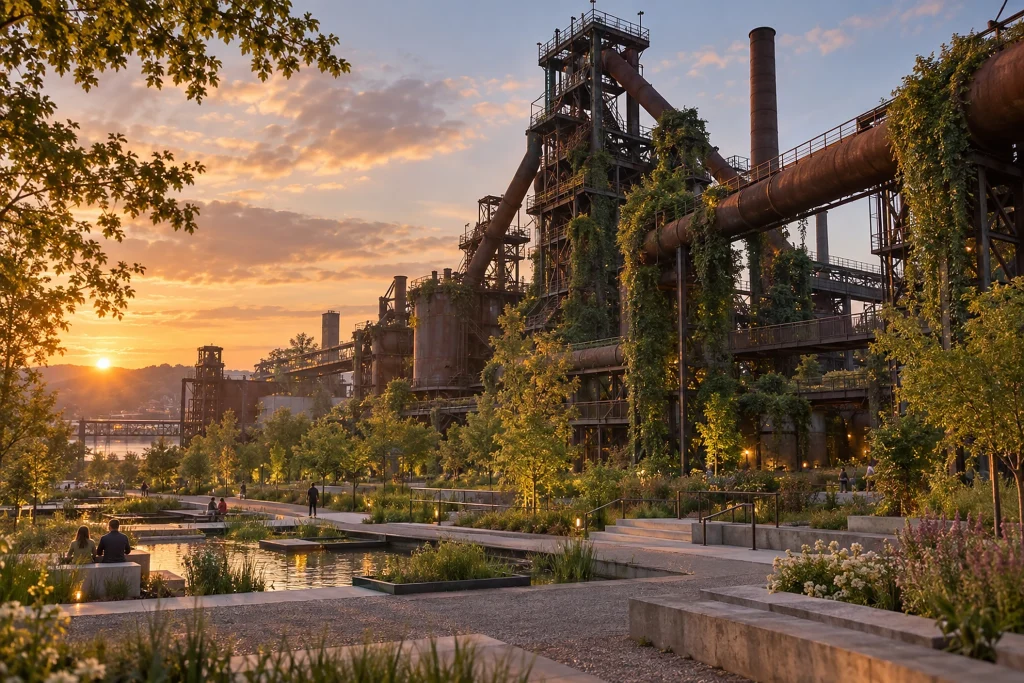
Landschaftspark Duisburg-Nord in the German city of Duisburg is an unusual visitor attraction created by transforming a former industrial facility into a park. Located among the remains of the heavy industry that developed in the Ruhr region due to its coal and iron ore deposits, the facility was used as a Thyssen ironworks until 1985. During the redevelopment, the main structures were preserved while the surrounding contaminated industrial land was redesigned.
The park contains three blast furnaces and their associated ore and gas processing facilities. The largest and newest, Blast Furnace 5, can be visited free of charge, and visitors can climb to the upper section of the structure. As it was decommissioned while still in good condition after being renovated recently, the furnace can be accessed via numerous walkways, except for several sections closed for safety reasons. The highest accessible point is the platform above the charging chute, 70 meters above the ground.
In the blast furnace, the oxygen in iron ore is removed through carbon monoxide. Iron ore and carbon are fed in from the top of the furnace, while air is blown in from the bottom. The amount of air is adjusted so that the carbon produces carbon monoxide instead of burning completely. The chemical reaction takes place as the hot gas rises, while molten iron and slag separated from the ore collect at the bottom. Minerals such as limestone are also added as fluxes. Because the facility is an industrial remnant, there is no elevator.
Why it matters
Landschaftspark Duisburg-Nord shows that structures rendered obsolete by the end of heavy industry can be transformed into public spaces rather than being completely demolished. The preservation of the main facilities and the redevelopment of the contaminated land demonstrate that industrial heritage is being treated not merely as a past put on display, but as a place that can be visited. This approach is meaningful not only for those interested in industrial history, but also for visitors who want to understand the chemical and physical processes of iron production on site. At the same time, the original features of the industrial structure limit access; the absence of an elevator and the closure of some sections for safety reasons show that the balance between preservation and accessibility for everyone remains an open issue.