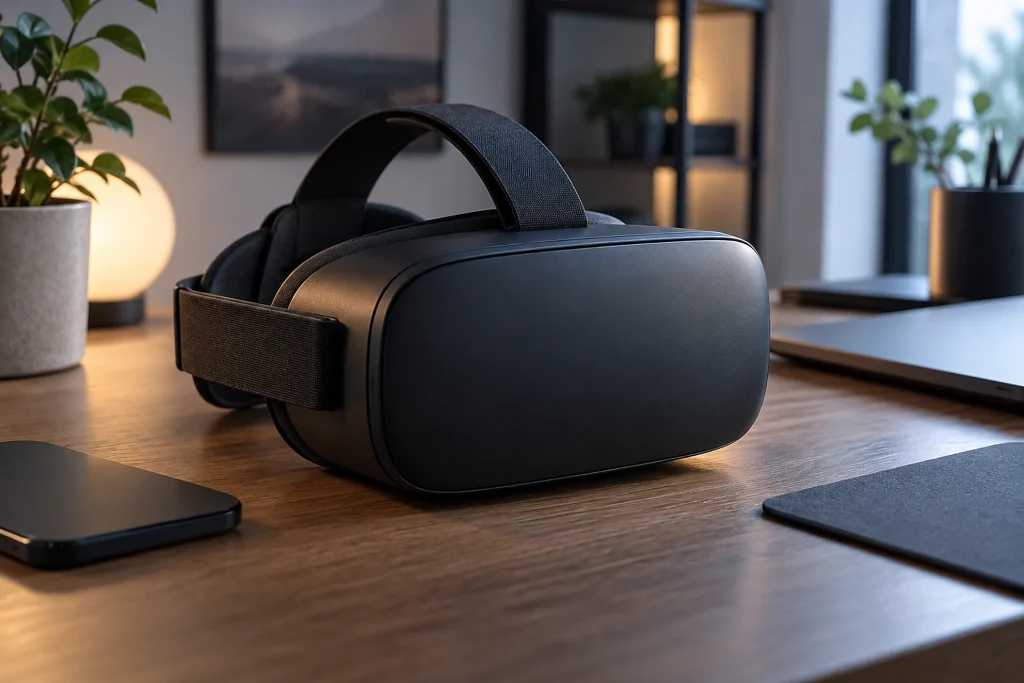
Valve is returning to its long-sidelined VR efforts with Steam Frame, a $1,059 standalone virtual reality headset that opened for reservations in 2026. After about a week of use, the device feels unfinished due to battery, software and performance issues, despite its comfortable and detailed design.
Steam Frame weighs 440 g, about 15% less than the Meta Quest 3’s 515 g. Placing the 21.6 Wh battery at the back of the head balances the weight and reduces forward pressure during extended use. However, the rear battery makes it difficult to lean back while wearing the headset and may also put pressure on the frames of users who wear glasses.
The device offers a resolution of 2160 x 2160 per eye, a refresh rate of up to 144 Hz and a 110-degree field of view. External cameras provide base-station-free tracking and passthrough functionality. Eye tracking, foveated rendering and an SD card slot are also included. Alongside the 256GB model, a $1,299 version with 1TB of storage is available. The controllers are based on the Meta Quest design while including additional buttons and a directional pad.
During rapid movements, head tracking may exhibit jitter and image ghosting. In “Performance” mode, the battery barely lasts more than an hour and a half in most VR games, while the fan constantly blows hot air and produces audible noise. “Playtime” mode extends battery life beyond two hours but lowers the resolution and usually drops to 72 Hz.
Wireless streaming from a nearby PC generally works with latency of five to ten milliseconds thanks to the included 6 GHz Wi‑Fi USB adapter, although establishing the connection sometimes requires a restart. Compatibility is a more serious issue with SteamOS adapted for ARM-based hardware. Doom VFR and I Expect You To Die 3 failed to launch, while Fruit Ninja and The Lab displayed graphical glitches; during testing, crashes in various games required the device to be restarted six times. The “Great on Frame” list includes only a few dozen titles among thousands of SteamVR games.
The Qualcomm Snapdragon 8 Gen 3 is also limited in non-VR games; Returnal delivered 9 fps at 720p on “Low” settings. By contrast, the bundled Half-Life: Alyx runs standalone with few compromises thanks to custom optimizations.
In its conclusion, the review finds the Steam Frame, cited at $1,049, expensive for most users compared with the $599 Meta Quest 3 or $349 Quest 3S. Although its light weight, the ability to avoid a Meta account, Linux desktop access and the Steam VR library offer advantages, the high price, short battery life and software issues limit its appeal.
Why it matters
The real test for Steam Frame is the extent to which Valve can make its vast SteamVR library usable on a standalone headset; the current compatibility list and errors encountered in testing show a clear gap between the size of the library and the number of games that actually run without problems. This is particularly relevant to those who want to access Steam games without being tethered to a PC and those who prefer to avoid a Meta account. Although the lightweight, balanced design provides comfort, short battery life, performance loss and issues requiring restarts make whether the high price is justified depend more on software maturity than hardware. The difference between the custom optimization in Half-Life: Alyx and the results in other games leaves open the question of whether the experience stems from the platform’s overall capabilities or game-specific adaptations.
Background
Steam is not a new name in the FikirPilot archive: over the past 90 days, we have published 12 news articles mentioning the name, the latest dated September 15, 2026.