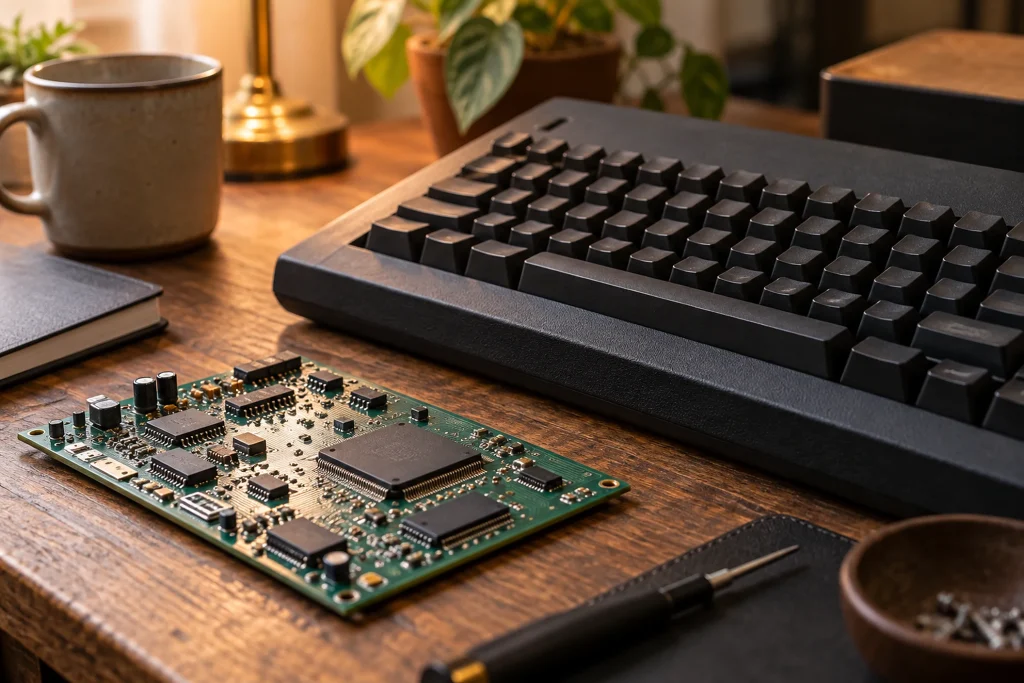
Released in 1981, the Sinclair ZX81 reflected Sir Clive’s approach of doing the most with minimal hardware: it had 1K of memory, along with a keyboard, Z80, TC and cassette interfaces. 45 years later, [adam.klotblixt] brought together ZX81 expansions in the OpenSpand he developed. User-configurable RAM uses the 64K address space outside ROM, while the SD card works with Sinclair BASIC’s LOAD and SAVE commands. The system also offers high-resolution graphics, emulated sound chips, joystick and serial ports, ROM options and composite video output. There is no printer interface. Alongside physical components, the RP2350 also emulates the internal RAM and ROM that it disables.
Why it matters
OpenSpand makes the original system more usable by bringing the ZX81’s limited architecture, which relies on separate expansions for different functions, together on a single board. The SD card’s compatibility with Sinclair BASIC’s existing commands adds new storage capabilities to the system without changing how software was used at the time. The configurable memory, graphics, audio, connectivity and display options are particularly relevant to users who run or develop ZX81 software on real hardware. The RP2350’s use of physical components for some functions and emulation for others shows that the project aims to supplement the original architecture’s shortcomings with modern hardware rather than reproduce it in full. The lack of a printer interface, however, shows that it is not a complete solution covering all ZX81 peripherals.