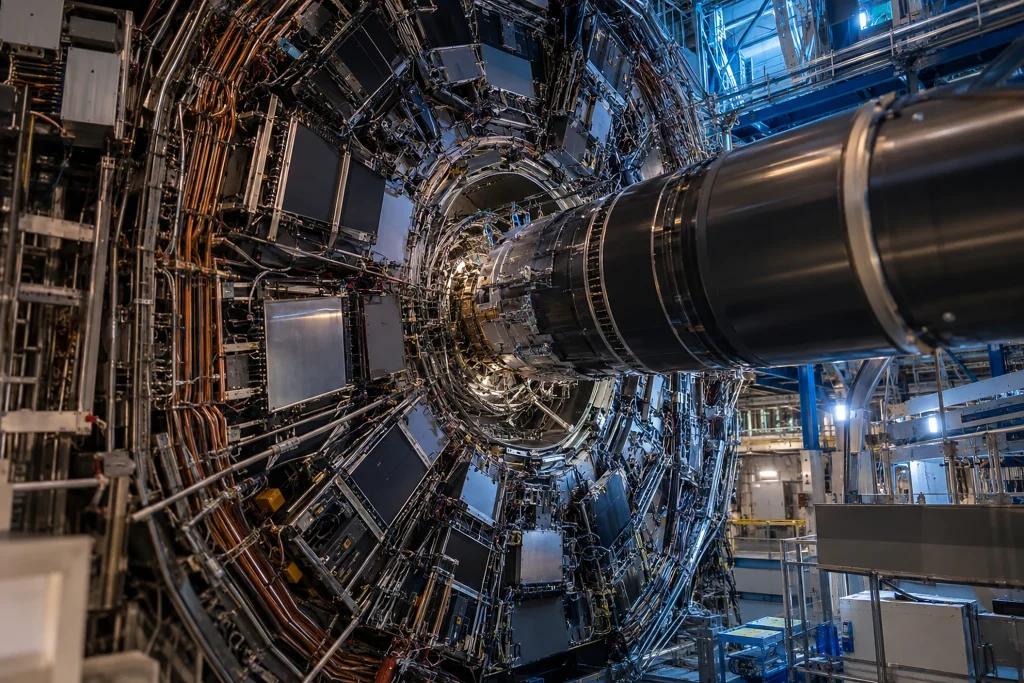
Scientists have found strong evidence that quantum entanglement can occur between heavy, extremely short-lived particles. Entanglement, which means particles originating from the same source remain connected regardless of distance and which Einstein called “spooky action at a distance,” underpins secure communication networks and quantum computers. In the ATLAS experiment at CERN, protons were collided at 99.99% of the speed of light, producing 13 trillion electron volts of energy and the Higgs boson. Discovered in 2012, the Higgs proved the existence of the field that gives particles mass. The first strong evidence of entanglement was detected in two Z bosons produced by the decay of the Higgs. The directions of the electrons and muons left behind by Z bosons, which decay in far less than a second, were measured with the ATLAS detector.
Why it matters
The finding expands the scope of entanglement research to heavy and extremely short-lived particles. Higgs decay makes it possible to examine processes linked to the field that gives particles mass and quantum entanglement within the same experimental framework. Because Z bosons decay in a very short time, the analysis relies on measuring the directions of the electrons and muons they leave behind rather than the particles themselves, making the role of the ATLAS detector crucial. While the result shows that the phenomenon underlying secure communication networks and quantum computers can also be investigated in high-energy particle collisions, the fact that the current data amounts to strong evidence preserves the distinction between definitive confirmation and a strong experimental indication.