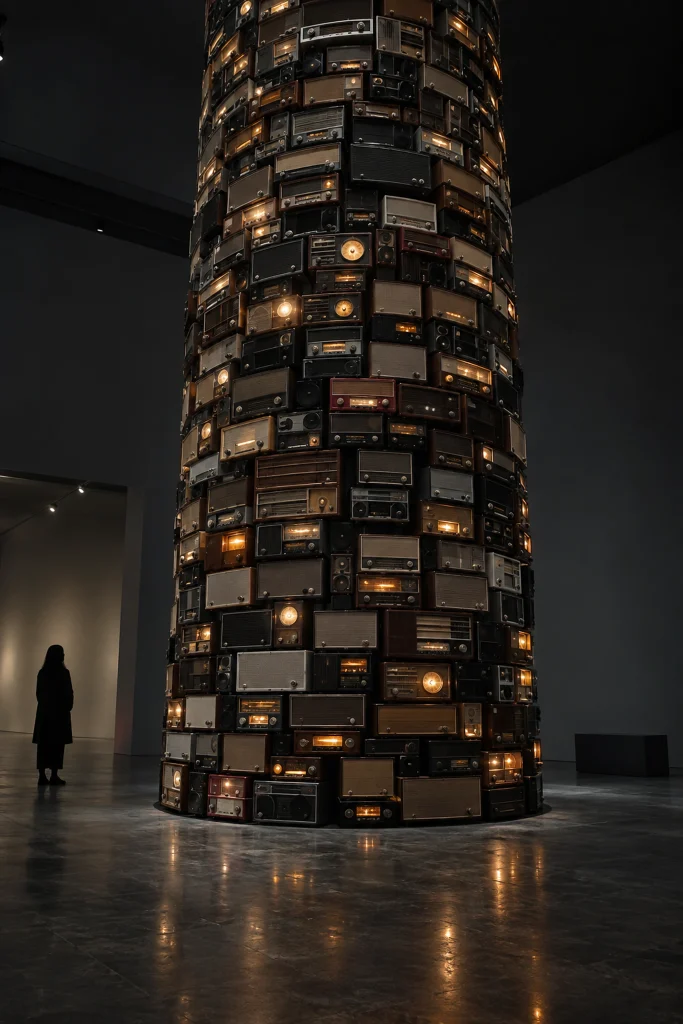
Cildo Meireles’ Babel brings together in the same space the languages, news, music and lives carried by hundreds of radios broadcasting on different frequencies. Yet this coexistence does not become a shared voice; as the sounds multiply, it becomes harder to reach individual meanings. The work, which Meireles describes as a “tower of incomprehensibility,” questions not so much the failure of communication as how meaning can be preserved when different voices exist simultaneously.
Babel does not reject polyphony; while showing that different languages, experiences and perspectives provide cultural vitality, it draws attention to the threshold at which the differences that make meaning possible disappear. The difference between a voice existing, being heard and being understood raises questions of power and visibility through which languages enter circulation, which narratives occupy the center, and which become ineffective amid the crowd. Moacir dos Anjos’s interpretations address the work in the context of globalization and unequal communication.
In the present day, when the intensity of information and notifications fragments attention, the difference between importance and urgency is erased. The work opens up a discussion on dwelling on thought, on the construction of meaning through the distance and silence between voices, and on how different voices can be heard without silencing one another.
Why it matters
This text is less an announcement of a current development than a critical essay interpreting an artwork through the problems of communication and meaning. This distinction shows that the work should be evaluated in the context of art criticism rather than treated as a news subject. The article’s central question is whether the coexistence of numerous voices alone creates an equal environment for communication; this question points to how relations of visibility and power can be debated through art. The connection to globalization and unequal communication established through Moacir dos Anjos’s interpretations takes the work beyond being merely an aesthetic experience and places it within a conceptual framework examining the limits of cultural circulation. For this reason, the text should be read less as news than as an assessment contributing to thinking about art.