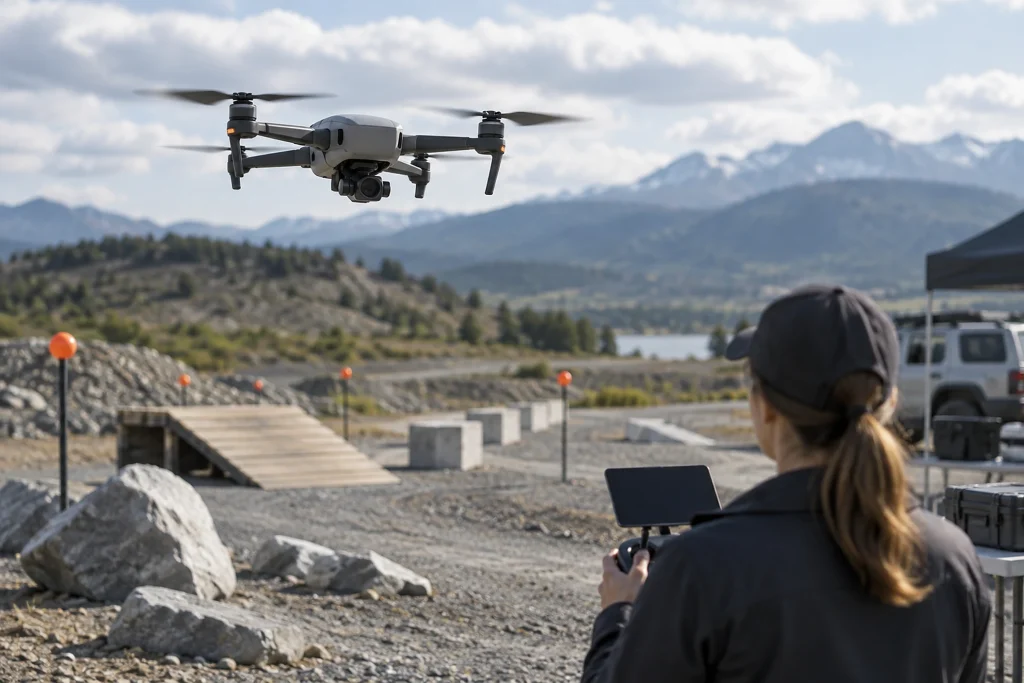
At TEKNOFEST 2026, the Advanced Autonomous Systems Design and Operations Competition, organized under the main coordination of T.C. Sanayi ve Teknoloji Bakanlığı (Türkiye’s Ministry of Industry and Technology) and T3 Foundation, with TUSAŞ (Türkiye’s aerospace and defense company) as the executing organization, aims to improve young people’s skills in unmanned systems, artificial intelligence, image processing and communications. In the mission simulating post-disaster conditions, the unmanned aerial vehicle (UAV) is expected to autonomously explore the area, determine the open route and transmit the information to the Ground Control Station and the unmanned ground vehicle (UGV), and then make a safe landing. The UGV’s route tracking will not be included in this year’s final and is planned for next year.
A total of 118 teams and 727 people applied for the competition; 30 teams and 263 participants reached the final. The finalists come from 13 provinces of Türkiye and Macedonia. Reports, presentations, system inspections and flight tests will be evaluated during the process. Technical presentations will be held on 21-22 September, and field tests on 23-25 September. 20 successful teams will advance to the final round.
- First place: 750 thousand TL
- Second place: 600 thousand TL
- Third place: 500 thousand TL
Why it matters
The competition’s primary significance lies in testing, within the same mission chain, the capacity of autonomous systems to perceive their surroundings, make decisions and transmit the information they obtain to the relevant units under complex conditions such as those following a disaster. This framework makes visible not only flight performance but also the coordination between artificial intelligence, image processing, communications and system design. Evaluating teams from different provinces of Türkiye and Macedonia according to the same technical criteria allows these skills to be compared across teams. The fact that İKA’s route tracking is outside the scope of this year’s competition shows that ground-air coordination has not yet entered the competition’s full evaluation scope. Thus, the results can be interpreted not only in terms of the young participants’ individual technical skills but also their ability to operate different systems together.
Background
Disaster is not a new name in the FikirPilot archive: we published a report mentioning this name in the last 90 days; that article is dated September 24, 2026.