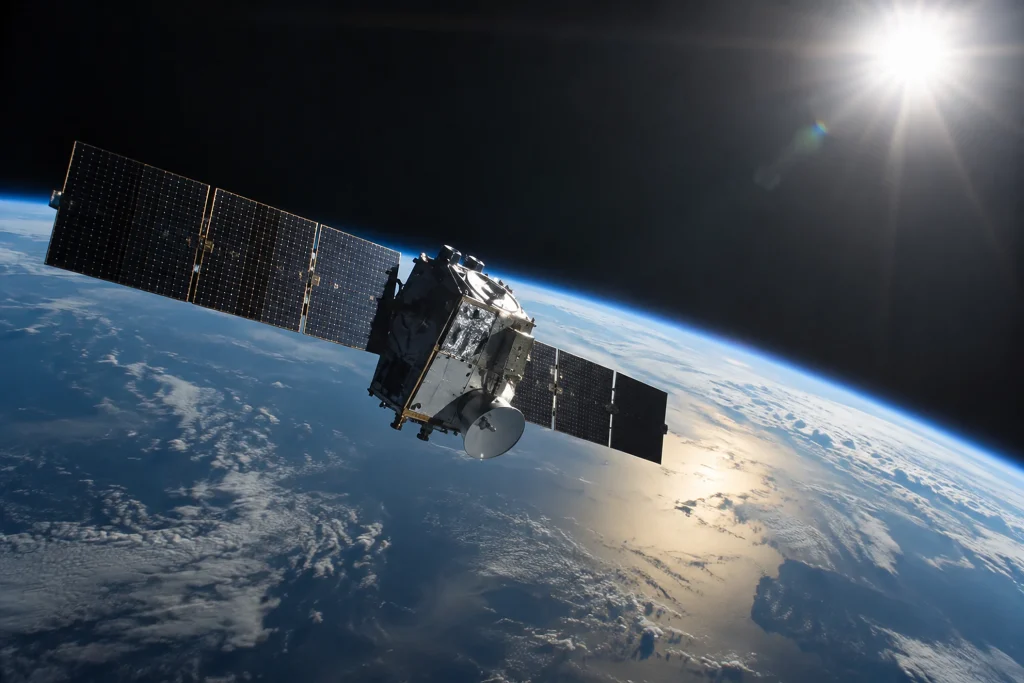
The US military has confirmed for the first time that it has deployed “space control weapons” in orbit capable of protecting joint forces against hostile actions. Meink made the announcement at the Air and Space Forces Association’s annual Air, Space & Cyber Conference near Washington, DC. He did not provide information about the type of weapons, when they were deployed or whether they had been tested. Saying that disclosing details would not contribute to deterrence, Meink stated that the US must be able to operate freely in the space environment, which is critical to military and economic security.
The Pentagon’s announcement revealed a shift in the US approach to space warfare. In recent years, military officials have begun speaking more openly about conflict in orbit, defensive measures on satellites and ground-based systems designed to neutralize enemy satellites.
The US had raised concerns that Russia tested what appeared to be an anti-satellite weapon in orbit in 2020. Biden administration officials accused Russia in 2024 of deploying operational anti-satellite weapons. Rep. Mike Turner (R-Ohio) also disclosed that year a US government assessment that Russia could place nuclear weapons in space. A nuclear explosion in low Earth orbit could endanger thousands of spacecraft, including Starlink satellites, US spy satellites, Chinese satellites and the International Space Station.
US officials are also concerned about China’s highly maneuverable satellites. Open-source data indicates that Chinese satellites have approached US military assets, likely for surveillance purposes. The Center for Strategic and International Studies’ 2025 Space Threat Assessment report stated that these capabilities could develop into a powerful orbital counterspace arsenal. Meink also justified the US deployment by citing systems that China and Russia have been developing for more than a decade.
Space weapons can include directed-energy systems such as lasers, radio-frequency jammers and kinetic weapons that physically destroy targets. Gen. Chance Saltzman said in 2025 that other countries were developing all six categories, while the US was not yet pursuing all of them. In June, the Space Force declared operational its first officially recognized weapon system, a mobile, ground-based satellite jammer called Meadowlands.
Victoria Samson assessed that the disclosed systems could be jammers deployed in orbit. Clayton Swope said the announcement was too vague to serve as a deterrent, as the weapons’ targets and conditions of use were unknown. There was no immediate response from the governments of China and Russia on Monday.
Why it matters
This confirmation shows that space is being treated not merely as a domain providing support services, but as a direct arena for military confrontation. The development reveals that the US response to anti-satellite capabilities originating from Russia and China is no longer limited to ground-based jammers, while also affecting thousands of spacecraft using the same orbits, as well as military communications and surveillance systems. However, because the systems’ type, testing status, targets and conditions of use have not been disclosed, it is not possible to independently assess the deployment’s deterrence value or potential risks. This uncertainty leaves open the questions of how an intervention in orbit would be identified and under what circumstances it would be considered a hostile act, while keeping sensitive capabilities secret.