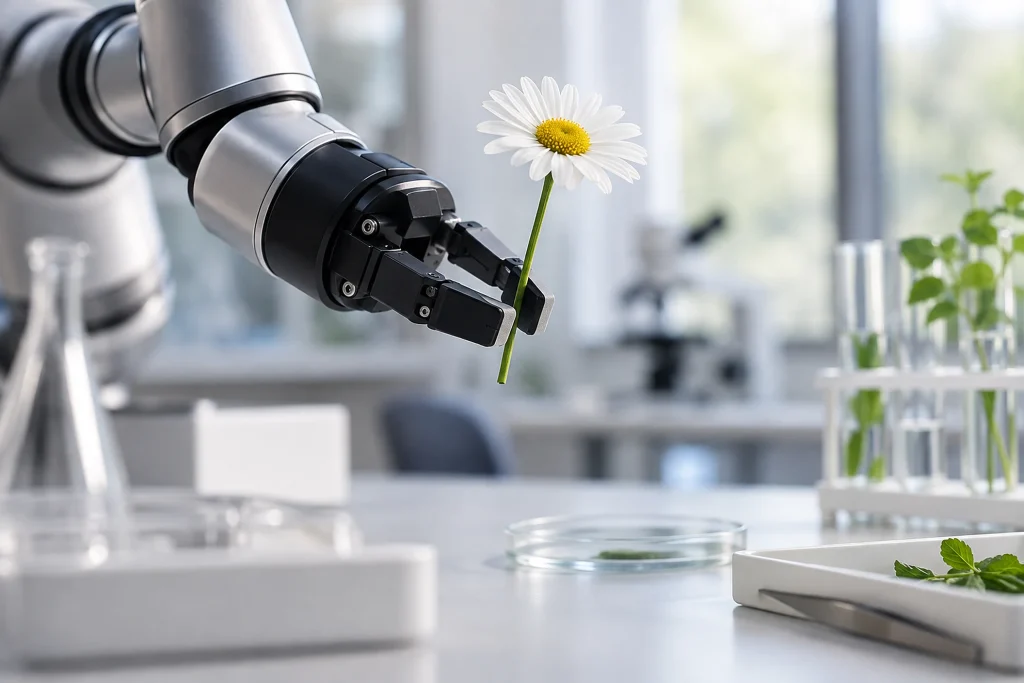
Jude Robinson’s Daisy robot creates a chain by threading real daisies together. The system, a student capstone project, uses mechanical constraints instead of sensing; the daisies are transferred to the tools in a repeatable manner. The robot consists of two X-Y gantries with opposing grippers. A conveyor between them feeds the daisies, while the upper blade and the thin threading rod beside it are used in the process. The gripper passes the stem through the hole in the previous flower; then a short slit is made in the stem with a scalpel, and the rod is inserted into the new hole. The gantries operate in sequence. The shape and diameter of the stem are decisive for reliability; V-shaped grippers center the stems, while the blade sheath also provides support. This mechanical approach is used in applications ranging from nut separators to paper airplane machines.
Why it matters
Daisy shows that not every problem in robotic systems has to be solved through sensing and software; the right mechanical constraints can also provide a repeatable process. This approach offers a concrete example, particularly for students interested in robotics and mechanical design, of placing the physical properties of the material at the center of the design. Because the system’s reliability depends on variables such as the shape and diameter of the stems used, success depends not only on the robot’s movements but also on how consistent the material being processed is. The key question left open, therefore, is to what extent the same mechanical arrangement could be adapted to flowers with different characteristics or to similarly variable materials.ાજપ