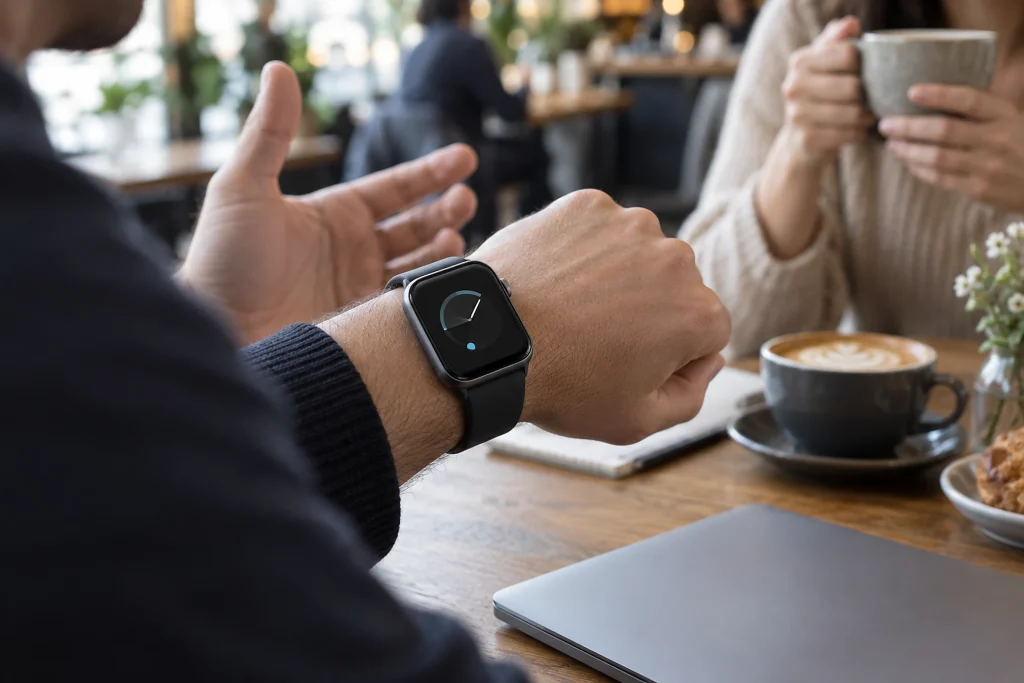
At the Surprise and Shine event on September 9, 2026, Apple introduced new hardware and also announced features that enable Apple Watches to process live audio and transcribe conversations. The company says this does not mean users are being recorded continuously; however, the technology is sparking debate over privacy and consent. While AI-powered voice transcription has recently been used to record meeting notes, lectures, and interviews, devices such as Friend and Amazon’s Bee offer always-on AI assistants.
Apple’s “Audio Intelligence,” “Live Rewind,” and “Siri Recap” features occupy the boundary between accessibility and privacy. “Audio Intelligence” uses on-device AI to detect sounds such as sirens, alarms, doorbells, and crying babies and alert users, even when an iPhone is not nearby. The feature is said to be able to help people who are deaf or hard of hearing when a fire alarm or carbon monoxide detector is activated.
“Live Rewind” transcribes what was just said by going back 15 seconds when the Digital Crown button on Apple Watch is pressed twice. The text can be saved to Apple’s new standalone Siri app for later review. While the feature could be used to remember a book recommendation or information that was missed, it could also result in a conversation being recorded when the person does not want to be recorded. This raises consent issues from both ethical and legal perspectives. While Plaud tells users to obtain the legally required permission, Amazon Bee’s terms of service place the responsibility for complying with laws concerning the privacy of children’s data on users. Since Apple does not store audio, it remains unclear how records kept only as text will be assessed in court.
“Siri Recap,” meanwhile, listens to the surroundings and creates headings, summaries, and key points rather than full transcripts of conversations. The feature will not be continuously enabled by default; users will be able to turn it on and off at specific times. Apple says it does not create or store audio recordings, that even Apple itself cannot access the raw audio, that it does not identify speakers, and that it encrypts summaries end to end. Whether this will be enough to address consumers’ privacy concerns remains unknown.
Why it matters
This development concerns people who are deaf or hard of hearing in particular, as well as anyone speaking in shared spaces, because it transforms smartwatches from devices that merely display user-specific information into tools that interpret sounds in their surroundings. While detecting sounds such as alarms and a baby crying improves accessibility, the possibility of conversations being transcribed without the user’s knowledge makes the boundaries of consent unclear. Users’ responsibility for children’s data and the necessary permissions means that using the technology is no longer merely a technical choice. Apple’s statement that it does not store audio, but does create text and summaries, also does not completely resolve the privacy debate. In particular, how texts retained in place of audio that has been deleted or not stored will be assessed in legal proceedings remains an open question.
Background
Apple is not a new name in the FikirPilot archive: we have published 31 reports mentioning the name in the last 90 days; the latest is dated September 10, 2026.