Basic information
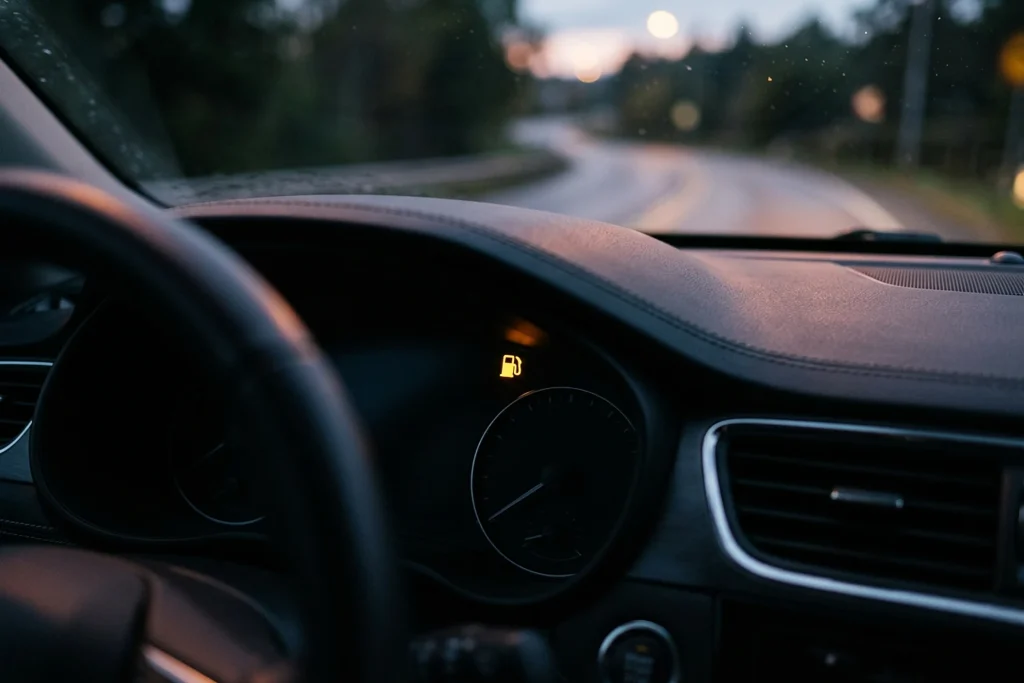
The fuel warning light does not indicate that the tank is empty, but that the fuel has dropped below a certain level; manufacturers set the system to leave a reserve so that the driver can reach a station. Since the distance that can be covered after the light comes on depends on the fuel remaining in the tank and the consumption at that moment, figures such as “it will go 50 kilometers after the light comes on” cannot be applied to all cars. With the same amount of fuel, a car that consumes 5 liters per 100 kilometers can travel farther than one that consumes 10 liters; however, the driver cannot know exactly how many liters remain in the tank.
How the mechanism works
The remaining range shown on the trip computer is an estimated value calculated from past consumption data. City traffic, a steep hill, a headwind, or aggressive use of the accelerator can quickly reduce the range; in economical driving, it may decrease more slowly than expected. Since the vehicle’s incline and the movement of the fuel inside the tank affect the measurement, seeing 20 kilometers on the display does not mean that this distance is guaranteed.
Engine behavior
In some vehicles, when the fuel gets very low, a line is displayed instead of a number.
If the fuel runs out completely:
- The engine stops; if this happens in traffic, it also creates a safety problem.
- In diesel vehicles, air can enter the system; the procedure specified by the manufacturer may be required to restart it.
Petrol vehicle facts
- In petrol vehicles, keeping the level constantly low can adversely affect the cooling and supply of the fuel pump.
- Repeatedly cranking the starter after the engine begins to misfire is not a solution either.
The safest approach is to treat the light as a sign that fuel should be obtained at the nearest suitable station.