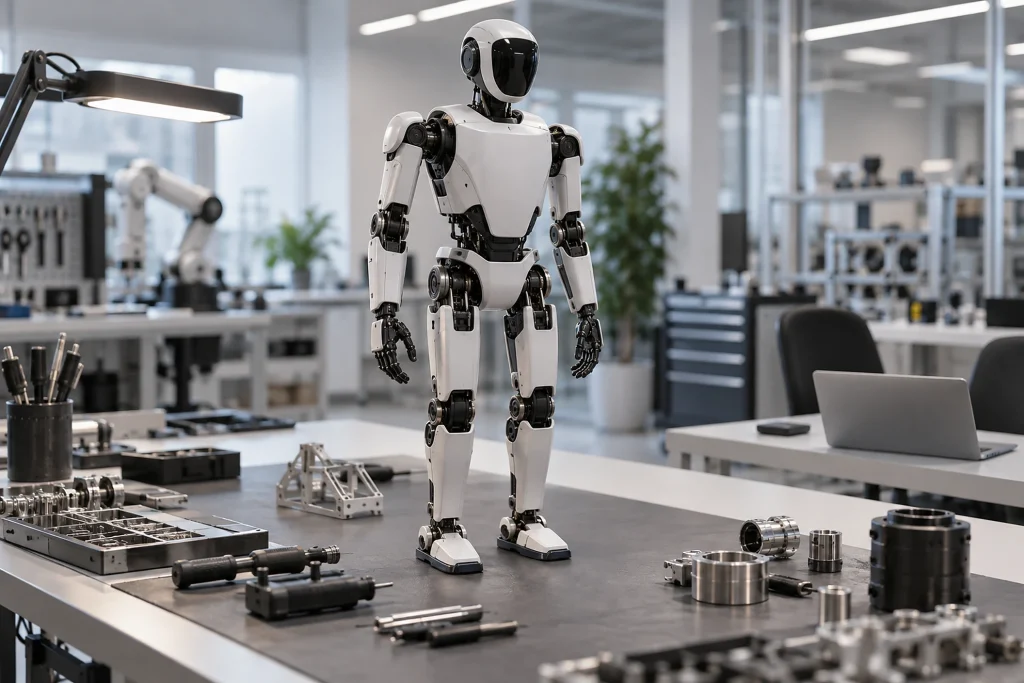
Unitree founder Wang Xingxing amassed a significant fortune after the company went public on the Shanghai Stock Exchange STAR Market on August 19. Wang, who also attended a business symposium hosted by Chinese President Xi Jinping in 2025, had his management style examined in a Caijing Magazine report published on August 31 and translated into English by ChinaTalk on September 10.
According to employees and investors, Wang personally makes nearly every decision, from company strategy to material colors and screw lengths. His focus on detail and cost-cutting has enabled Unitree to produce some of the cheapest walking robots on the market. The Unitree G1 for developers sells for $13,500, excluding shipping, while the consumer-oriented R1 is priced at $4,900. However, employees said return rates for repairs were “extremely high” in the early years, though the products later improved enough to meet their one-year or six-month warranty periods.
Wang, who has a background in hardware structural engineering, reportedly works at the office even on weekends and sends work messages at 2 or 3 a.m. Wang’s centralization of decision-making, including personally approving expense reimbursements exceeding 100 yuan (approximately $15), causes employees to wait to reach him. At the company, which grew to at least 480 employees this year, incentives were alleged to be based more on penalties than rewards. One employee said the company experienced the highest loss of core staff in its history in 2025 and 2026. Unitree argued that the report contained significant “misinformation” but provided no details.
Although Wang had previously been skeptical about the computing requirements of large world models, he said during the IPO that they aimed to use large AI models for physical AI. China expects to produce more than 100,000 humanoid robots in 2026 in a sector where companies such as AgiBot Robotics and UBTECH also compete. In 2025, only 14,000 humanoid robots were produced worldwide, most of them in China.
Although Unitree is profitable, its main customers are universities and research institutions, while industrial use is limited to small pilot projects. As the shares fell 50% from their peak, the valuation stood at approximately $30 billion. The U.S. ban on imports of foreign robots from July 28 also prevented American institutions from purchasing Unitree products.
Why it matters
Unitree’s low-price advantage rests not only on engineering choices but also on the founder’s tight control over costs and decisions, raising the question of whether the same model will remain sustainable as the company grows. Although the decline in historically high return rates to levels that can be covered by warranty periods points to improvements in quality, the report provides no data on the products’ long-term durability. A customer base centered on universities and research institutions, together with industrial use remaining limited to pilot projects, makes the gap between the sector’s production expectations and current demand a decisive issue for investors. The shift in its approach to large AI models is reshaping the company’s technological direction in the physical AI race. Employee attrition, decision-making bottlenecks, the decline in shares and the U.S. import ban are simultaneously increasing pressures related to scaling, talent retention and market access.
Background
Unitree is not a new name in the FikirPilot archive: we published an article mentioning the company in the past 90 days; that article was dated August 25, 2026.
Term: initial public offering
An initial public offering is when a company’s shares begin trading on a stock exchange for the first time; while raising capital, the company also assumes an obligation to provide regular financial reporting to the public.