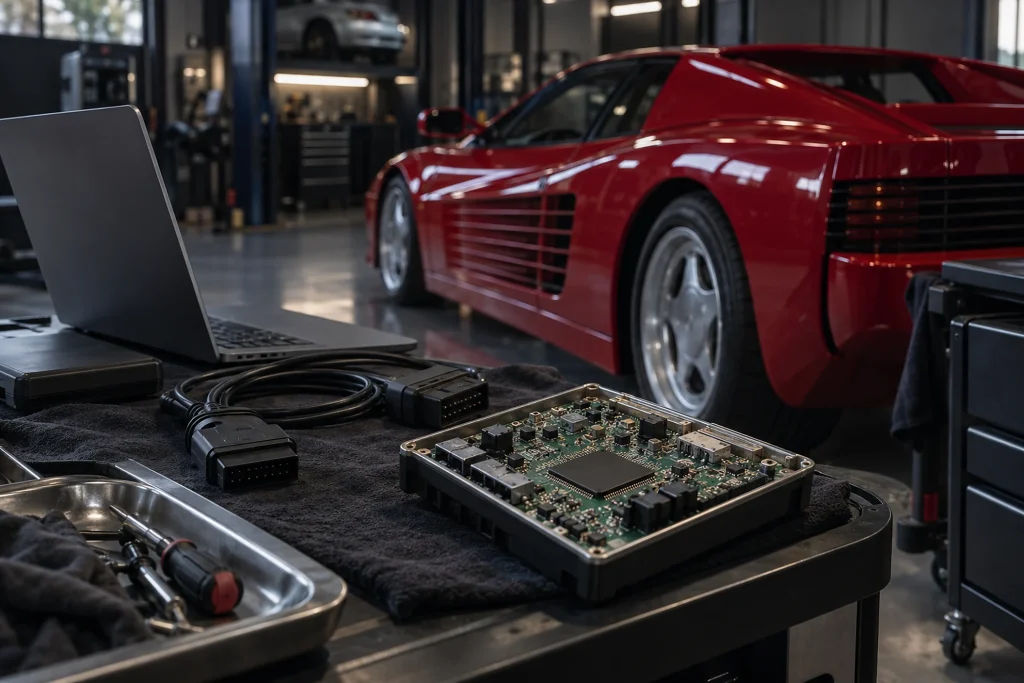
The owner of Jaguar XJ220 chassis #50, Tom Radom, developed an alternative diagnostic device after interfaces compatible with the Zytek ECU, SPD-1039, became increasingly rare. After using one of these interfaces when the check engine light came on last year, Radom found that the devices were difficult to find even within the limited owner market for 1990s Jaguar supercars. An attempt to open and reverse-engineer the interface failed because it was encased in silicone. Instead, he recorded the communication between the vehicle and the interface with a logic analyzer and built new hardware using an FT232RNL bridge. The original DOS-based diagnostic software continued to run in an emulator; only the hardware connection between the serial port and the vehicle was updated. Radom is providing the modules free of charge to XJ220, XJ220S, and XJR-15 owners. Applications can be submitted through the web form at Port220.com.
Why It Matters
This work shows that increasingly rare diagnostic interfaces are not merely technical components but also a factor determining access to the maintenance of older supercars. Particularly around the XJ220, XJ220S, and XJR-15, which have a limited number of owners, maintaining the hardware connection between the vehicle and the computer is becoming as important as preserving the original DOS-based software that works with the Zytek ECU. Offering the new modules free of charge turns the solution from a repair for a single vehicle into something available to owners dependent on the same infrastructure. As a result, the issue is no longer merely about resolving an individual fault but about preserving the number of vehicles that can be diagnosed; however, it is unclear whether this approach addresses other dependencies on original hardware or software.