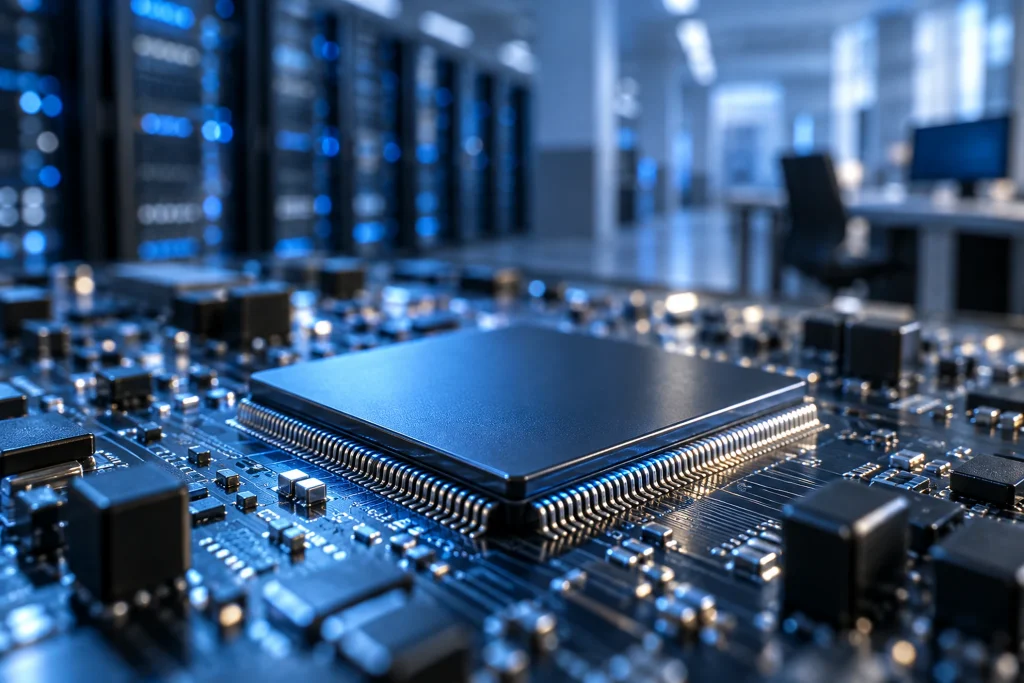
Huawei has brought forward the release of its next-generation Ascend 960DT artificial intelligence chip as part of its effort to rival Nvidia. The company announced at the Huawei Connect conference that the chip is expected to be ready in Q1 2027; the launch had previously been planned for Q3 2027. The announcement came one week before the expected meeting between Donald Trump and Xi Jinping in Washington, DC, on September 24.
Huawei aims to run hundreds of thousands and eventually millions of artificial intelligence chips as a single computer. The company calls this approach Peerium Computing Architecture. The system is based on UnifiedBus technology, which connects processors to memory, storage and networking hardware.
- Atlas 950 SuperPoD and SuperCluster are the first systems to use this architecture.
- Atlas 950 SuperCluster can connect up to 256,000 accelerator cards.
However, bringing forward the chip timeline also raised questions about Huawei’s broader artificial intelligence systems. Analyst Rui Ma said Huawei had previously stated that the Atlas 960 SuperPoD could scale to 15,488 Ascend 960 chips, while this week’s announcement referred to a system with 4,096 chips.
Huawei continues its chip development despite US measures restricting China’s access to advanced semiconductor technologies. Ma argued that these restrictions are unlikely to halt China’s efforts to develop its own semiconductor technology. Huawei executive Eric Xu, meanwhile, said Chinese companies need to accelerate artificial intelligence development in order to catch up with the US.
Why it matters
This development shows that Huawei continues to pursue the construction of not just a single chip but also very large-scale artificial intelligence infrastructure despite US measures restricting access to advanced semiconductors. The Peerium Computing Architecture and UnifiedBus approach reveals that the company is taking competition beyond processor performance and basing it on the interoperability of memory, storage and networking components. However, the discrepancy between the previous and newly announced figures regarding system capacity shows that the scale Huawei is targeting and the practical limits within which this architecture can be implemented have yet to become clear. Therefore, while the development reveals the direction of China’s efforts to develop domestic artificial intelligence technology, it leaves open the question of whether the planned chip roadmap aligns with actual system capacity.
Background
Nvidia is not a new name in the FikirPilot archive: we have published 30 stories mentioning the name in the past 90 days; the latest is dated September 19, 2026.
Term: semiconductor
A semiconductor is a material that conducts electricity depending on the conditions and is the foundation of processor manufacturing; in the industry, design, manufacturing and packaging are generally handled by separate companies.