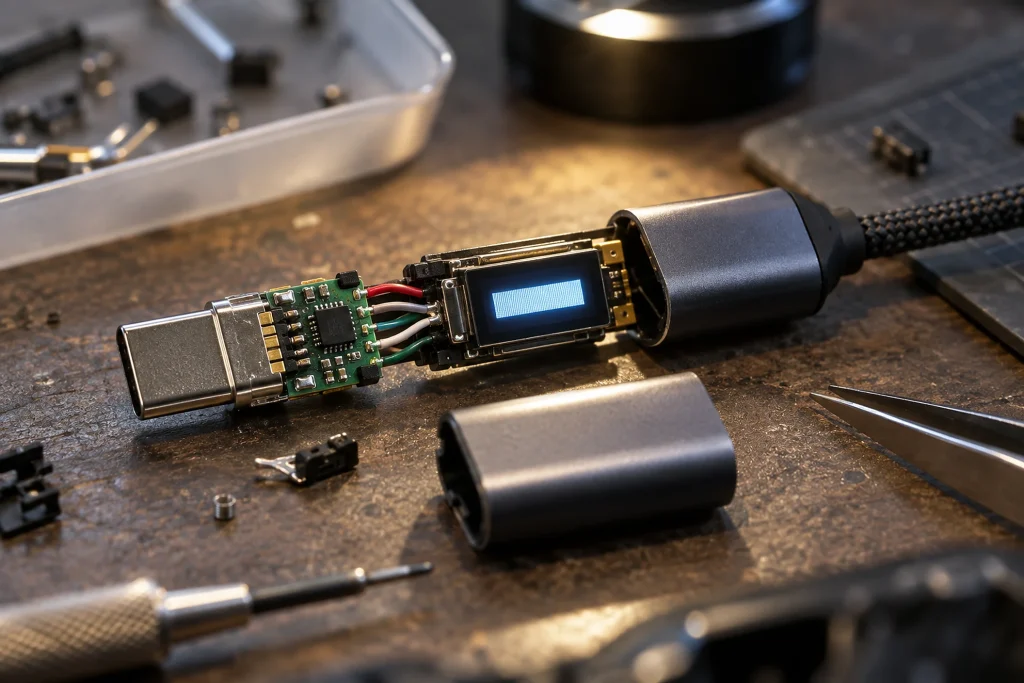
With displays still uncommon on USB-C cables, Aaron Christophel disassembled the €15, 240 Watt-rated UGreen cable to examine its internal structure and more than just its single-touch control. The display cover was removed using cutting tools; the aluminum housing was then opened with side cutters without applying heat. It was considered possible that adhesive had been used in the assembly.
- The small IPS LC display is connected to the PCB via a flat flex cable with a connector.
- The PCB contains various voltage regulators, a backlight MOSFET, and an MCU marked EN32LF056.
- The SWD interface showed that the MCU is based on Cortex-M0+, with 64 kB of Flash and 4 kB of SRAM.
Since the MCU only measures current and voltage, it cannot use the USB interface; however, if the SWD pads can be accessed, the product may be reprogrammed with custom software. Video frames were also displayed on the screen.
Why it matters
This review shows that USB-C cables with displays are not merely accessories that provide connectivity, but have evolved into more complex products containing a microcontroller that performs measurements and a separate display unit. This design requires the information presented by the cable on its display to be evaluated together with its hardware components and embedded software. While access to the SWD pads raises the possibility of modifying the firmware for hardware enthusiasts, it is not yet clear within what limits this could be done. The MCU’s inability to use the USB interface also leaves open the question of how the display could gain functions beyond showing measurement data. Therefore, the product offers a platform worth examining both for its physical design and its potential for reprogramming.
Background
USB is not a new name in the FikirPilot archive: we have published 4 reports mentioning it in the last 90 days; the latest is dated September 24, 2026.