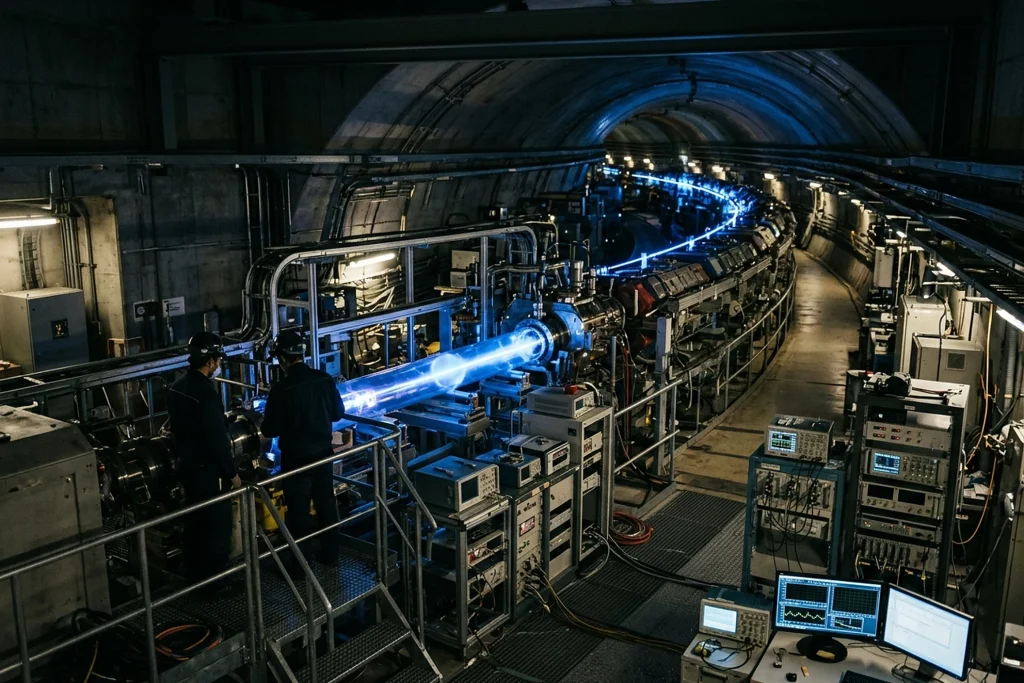
Scientists have put forward a new theory about why we exist. The study, published in the journal Physical Review Letters, examines the explanation for why matter prevailed over antimatter after the Big Bang, and suggests that the answer may lie in a long-overlooked particle called the “split” heavy neutrino. The answer may be in this particle.
Rishav Roshan, one of the paper’s authors from the University of Southampton, says the particle has been regarded for years as an insignificant detail and was thought to be too weak to affect other particles. Yet the particle decays very slowly. As the universe cooled, it survived for so long that at one point it came to dominate the universe’s energy density and triggered the phase in which matter became dominant. The researchers explain it as follows. According to the researchers, the particle shaped the matter-antimatter imbalance by altering the temperature at which electrons and other leptons interacted with their antiparticles via the Higgs boson in the early universe.
Roshan emphasizes that our being here is proof of the asymmetry between matter and antimatter. The findings also encompass dark matter. These findings could contribute to solving the mystery of dark matter, which makes up most of the mass in the universe but has never been seen, and the researchers note that the theory could be tested by examining gravitational waves reaching us from the early universe.
Why it matters
The imbalance between matter and antimatter is one of the fundamental questions physics has sought to answer for decades, because without this asymmetry, we would not exist in the universe. Placing a particle long regarded as an insignificant detail at the center of this question could require a reexamination of established assumptions about the early universe and directly concerns researchers working in particle physics and cosmology. The study’s extension, within the same framework, to the mystery of dark matter carries the potential to unite two of physics’ biggest open questions in a single mechanism. The fact that the theory can be tested through gravitational waves transforms it from a speculative idea into a verifiable or falsifiable prediction. The findings, however, remain at the theoretical level; the validity of the proposed scenario will only become clear through the examination of gravitational waves reaching us from the early universe, and until then it will remain an open question.
Background
Bilim is not a new name in the FikirPilot archive: we have published 8 stories featuring this name in the last 90 days, the most recent dated October 7, 2026.