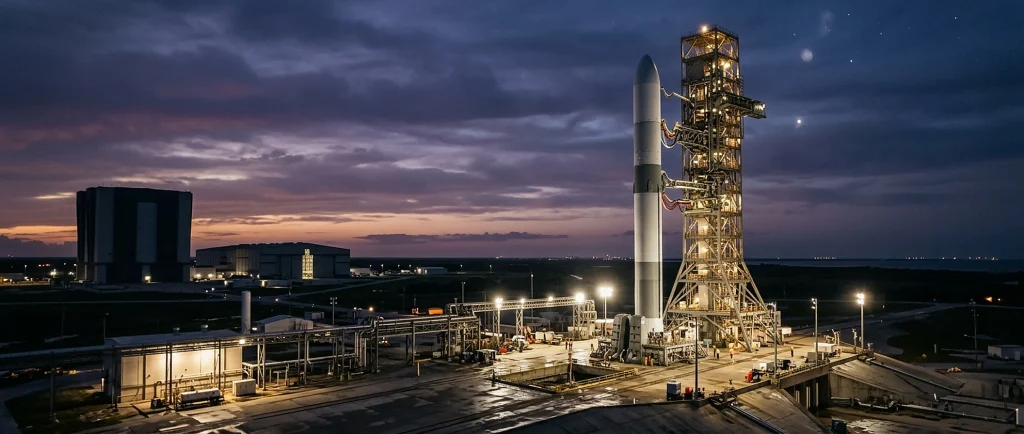
The United States’ space capacity is an ecosystem in which civil exploration, military-intelligence and commercial constellations share the same infrastructure. As of October 2026, this structure has restarted crewed lunar flight, has been operating a station without interruption for a quarter of a century, and holds roughly two-thirds of active satellites. Although the agency’s share, which exceeded 4 percent of federal spending during the Apollo era, has fallen to around 0.35 percent today, capacity has not shrunk; it has shifted to the commercial sphere. In 2025, the global space economy reached 686 billion dollars, 544 billion of which was commercial revenue; the United States alone accounted for 57 percent of the world’s government space spending.
According to the article, geopolitics is now six-dimensional:
- land, sea, air, space, cyber and cognitive.
In the institutional architecture, NASA owns Artemis and the science satellites; it operates with 10 centers, and its staff has fallen from roughly 18,000 at the start of 2025 to around 14,000 in 2026. Space Force, established in 2019, runs GPS and missile warning; Space Command, NRO, NOAA and the FAA make up the other layers. The Space Development Agency’s Tranche 1 layer reached approximately 84 satellites in the autumn of 2026, while the target remains 126. According to the author, Ukraine and the Middle East have demonstrated the necessity of multi-domain operations based on space-cyber integration.
Why it matters
This table shows that power in space can no longer be measured by the budget of a single institution; because capacity is shifting to the commercial domain as NASA shrinks, anyone seeking to assess US space superiority needs to look beyond public figures. Civilian, military and commercial systems sharing the same infrastructure means vulnerability as much as it does efficiency; in a conflict, the targeting of a single network could affect all three domains at once. The expansion of geopolitics to encompass the space, cyber and cognitive dimensions reveals that space has become not a separate agenda item but a central variable across many areas, from defense planning to economic policy. The fact that the experiences in Ukraine and the Middle East regard this integration as a necessity brings the question of dependence onto the agenda for countries that do not possess similar capacity. The analysis being cut short before completing the sections on crewed Moon flight and commercial constellations, meanwhile, leaves part of the scope promised by the table unanswered.