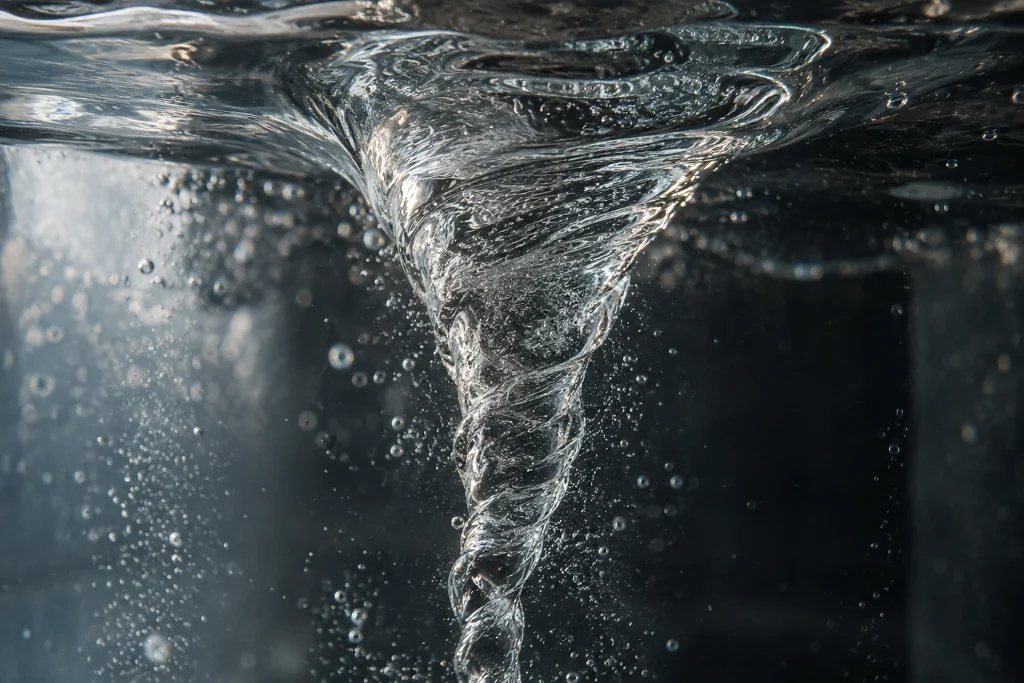
OpenAI announced that its most advanced artificial intelligence model had solved one of the Millennium Prize problems, each of which carries a US$1-million prize. The model mathematically demonstrated that the nineteenth-century Navier–Stokes equations, which describe the motion of fluids, can produce a “singularity” predicting physically impossible infinite velocities for gases or liquids.
The solution by the San Francisco, California-based company examines a situation in which a fluid vortex stretches and becomes extremely long and thin. According to George Karniadakis of Brown University, in air this occurs when the vortex narrows to approximately 70 nanometres in width. This distance corresponds to the typical distance an air molecule travels before colliding with another molecule. The Navier–Stokes equations treat a fluid as a continuous substance rather than as a collection of disordered molecules; at a scale involving only a few molecules, this assumption ceases to hold.
Charles Fefferman of Princeton University notes that it is already known that the equations can produce singularities in compressible fluids. The equations also fail to model rarefied gases well; as a result, they are inadequate for the re-entry of spacecraft into the upper atmosphere or for flows in microscopic channels.
One alternative is the Boltzmann equation, which treats gas through the statistical behavior of individual molecules. Yu Deng of the University of Chicago says it remains unclear whether these equations, too, could break down under certain conditions, and that understanding remains limited. Simulating molecules directly, meanwhile, is computationally expensive. In 2024, a supercomputer simulated 155 billion water molecules; this amount typically fills only a cube measuring a few micrometers on each side. Another approach is the “triple decker” method, which combines molecular dynamics at small scales, Navier–Stokes at large scales, and equations representing average behavior in between.
Why It Matters
This development highlights the question of the physical scales at which the equations used to explain fluid motion remain reliable. The loss of validity of the continuum assumption at the molecular scale makes the limitations of existing models particularly clear in areas such as re-entry into the upper atmosphere and flows in microscopic channels. The issue is not limited to the Navier–Stokes equations; it is also unknown whether the Boltzmann equations, which are based on the statistical behavior of molecules, can break down under certain conditions. Because modeling molecules directly requires high computational costs, methods that combine different scales are gaining prominence. However, under what conditions these approaches will produce reliable results and to what extent they will reduce existing uncertainties remain open questions.