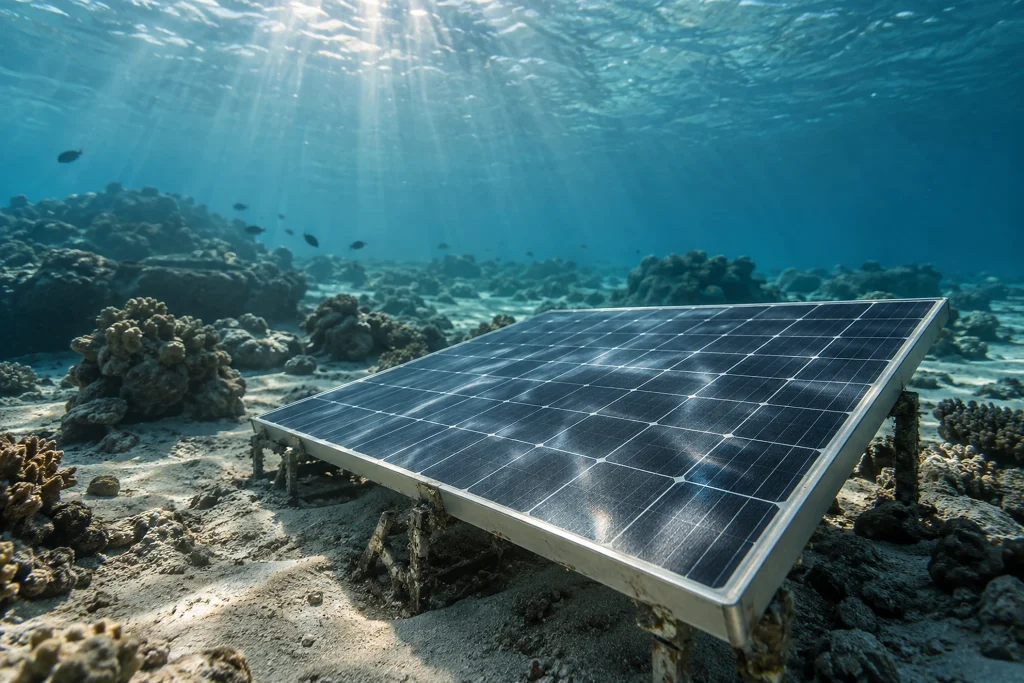
A new perovskite-based solar cell has been developed to generate electricity underwater. The main problem with perovskites, which can be cheaper, more flexible and more efficient than silicon, is that they degrade rapidly, particularly because of moisture. However, their ability to be tailored to different light wavelengths allows them to harness underwater light that silicon panels cannot use. Low light and cool conditions may also extend the cell’s lifespan.
Researchers used a polyhexamethylene guanidine hydrochloride additive to improve durability. While forming a water-repellent layer, the substance also enabled larger crystals to develop, restricted ion movement and improved electricity generation. In tests simulating light at a depth of about 10 meters, the cell converted approximately 35% of the light energy into electricity; the efficiency of silicon panels is generally around 20%.
The panel, prepared with protective layers, retained 99.6% of its initial efficiency after about 40 days in seawater. Researchers calculated that it could operate for 5.5 years before its efficiency fell to 80%. Attached to a small vehicle in the South China Sea, the panel charged button batteries for several hours at depths of 2, 6 and 10 meters. At 2 meters, waves caused fluctuations in output, while at greater depths the light was more stable but weaker. At 10 meters, energy generation was slightly less than a quarter of that at 2 meters. The design could reportedly be used in autonomous marine power systems and underwater Internet of Things infrastructure.
Why it matters
This approach offers a way to meet the energy needs of small underwater vehicles and Internet of Things infrastructure in situ. The ability to tune perovskites to different wavelengths turns underwater light that silicon panels cannot harness into a distinct application area. The fact that additives and protective layers limit both moisture-induced degradation and ion migration directly addresses the technology’s fundamental durability problem. However, because the field trial lasted several hours and the seawater test about 40 days, it remains unclear whether the calculated 5.5-year lifespan will be validated in real-world use. The decline in energy generation with depth is also one of the key constraints determining which devices can be powered by this system.