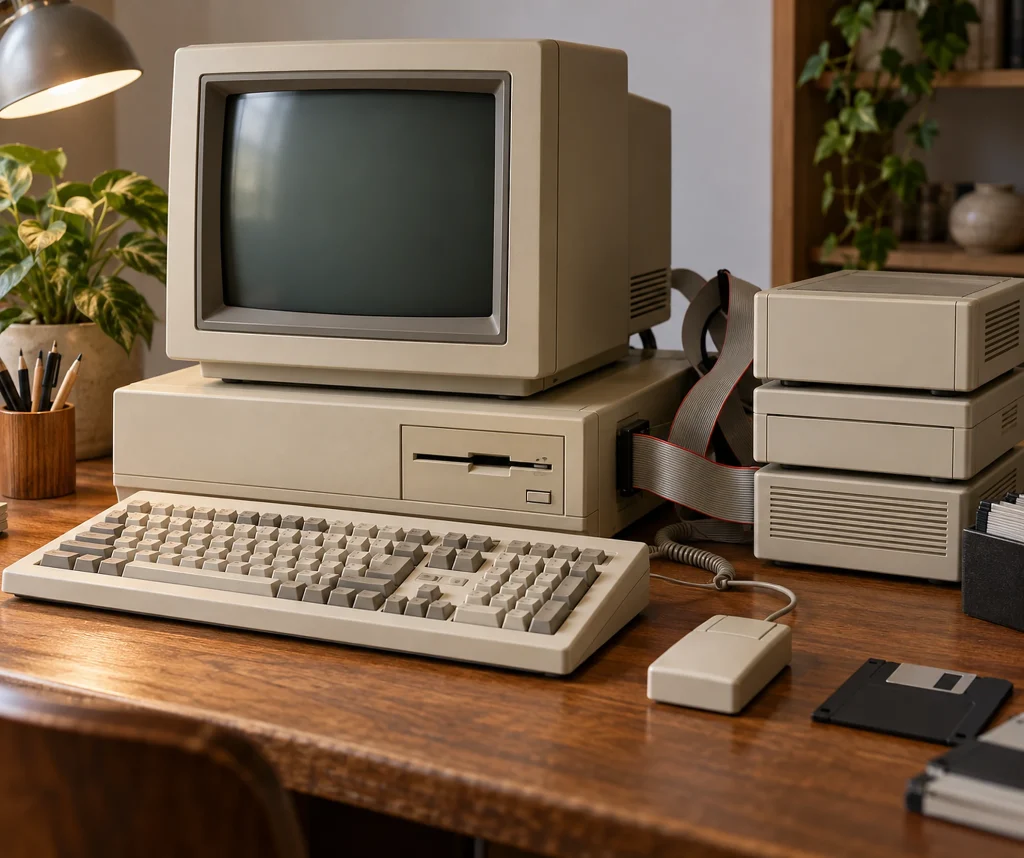
In 1982, when there were no clear leaders in the desktop computer market, Sony introduced the SMC-70 model. The device, with its unusual appearance, used a system in which modules were stacked and secured with special bars instead of expansion card slots; the modules could be arranged vertically or horizontally using ribbon or external cables. While the cases had to be opened for Altair’s S100 and the IBM PC’s ISA bus, this could be done externally on the SMC-70. The power supply of the device examined was repaired, and its original appearance was preserved with a 3D printer. The SMC-70 was a CP/M computer with a 4 MHz Z-80 processor; its 3.5-inch floppy disk drive was not common. Its standout features were 16-color graphics ahead of their time, sound support, and a video output module. The 8086 module introduced later did not run MS-DOS, but used CP/M-86. The red help key on the keyboard and the RAM disk also drew attention.
Why it matters
The importance of the SMC-70 lies in its approach to expansion in personal computers through a modular structure that could be arranged externally, unlike card slots inside the case. While this choice made the process of adding hardware and arranging components more visible to the user, it also opened up discussion about the relationship between a design based on special modules and standards. The combination of graphics, sound, and video support on a CP/M platform demonstrates the period’s search for uses extending beyond text-oriented computing. Examining the repaired example while preserving its original appearance makes it possible to evaluate this approach not only through its technical features but also alongside the history of physical design. Thus, the subject interests not only those who preserve old computers but also those exploring alternative paths in hardware design; the open question is within what limits this modularity was useful in practice.
Background
Sony is not a new name in the FikirPilot archive: we have published 8 articles mentioning this name in the past 90 days; the most recent is dated September 16, 2026.