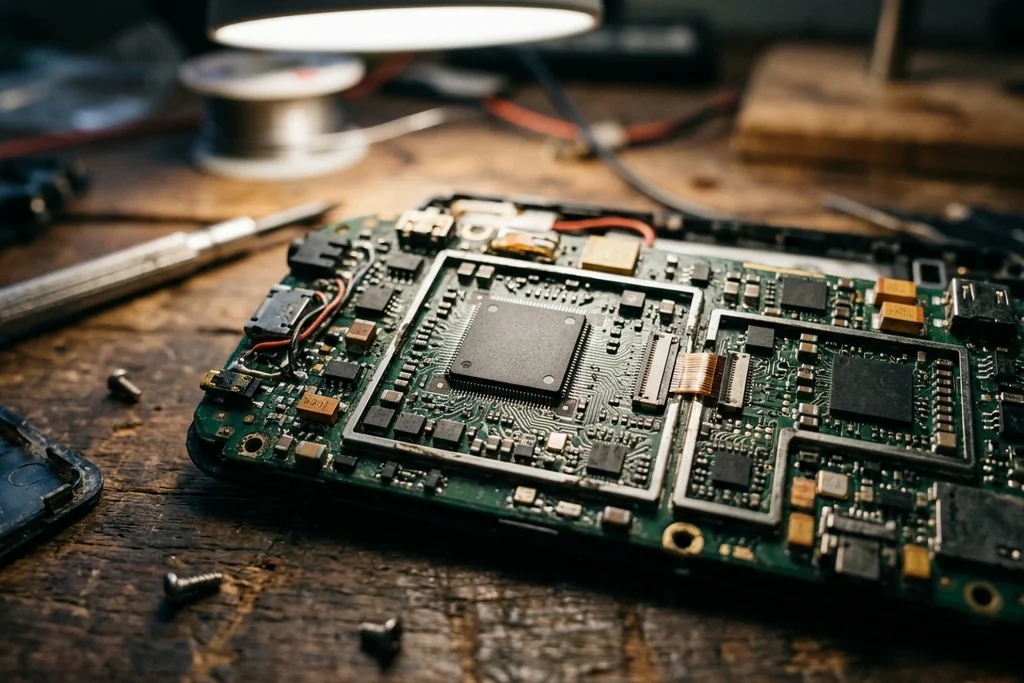
An attempt to run Linux on a 2011 Nokia E6 smartphone dating back to the Symbian era has resulted in the Linux operating system actually running. A developer named [fluffleswaffled] took a different approach because the device has a locked bootloader. This transition works in one direction only. A Symbian application loads the Linux kernel and the device tree into RAM, then disables the MMU and the caches to switch the system over to Linux. Returning to Symbian requires powering the device off and back on. In the setup, a terminal opens on the phone’s screen, while both the hardware keyboard and the touchscreen remain functional. The display is driven by the Broadcom VideoCore III. The developer captured messages coming from Nokia’s original driver and wrote a custom kernel driver. The phone stays in Linux for at most 3.5 minutes and then resets. The developer believes the baseband chip detects that Symbian has stopped and shuts the system down, and is asking for help from people experienced with Nokia basebands.
Why it matters
This experiment shows that the hardware of a device whose operating system support ended long ago can still be explored with new software. The fact that even on a phone with a locked bootloader, changing the operating system is only possible through a one-way and temporary transition via Symbian reveals the scale of the technical obstacles enthusiasts face without official support. As it stands, the project offers no practical use; the fact that the phone can stay on for no more than 3.5 minutes under Linux shows that the reset, believed to be caused by the baseband chip, is the main technical obstacle ahead of the developer. The developer’s call for people experienced with Nokia basebands is a reminder that the continuation of such projects often depends not on a single individual but on the contribution of a distributed network of knowledge.
Background
Linux is not a new name in the FikirPilot archive: we have published 7 news stories featuring this name in the last 90 days, the most recent of which is dated September 16, 2026.