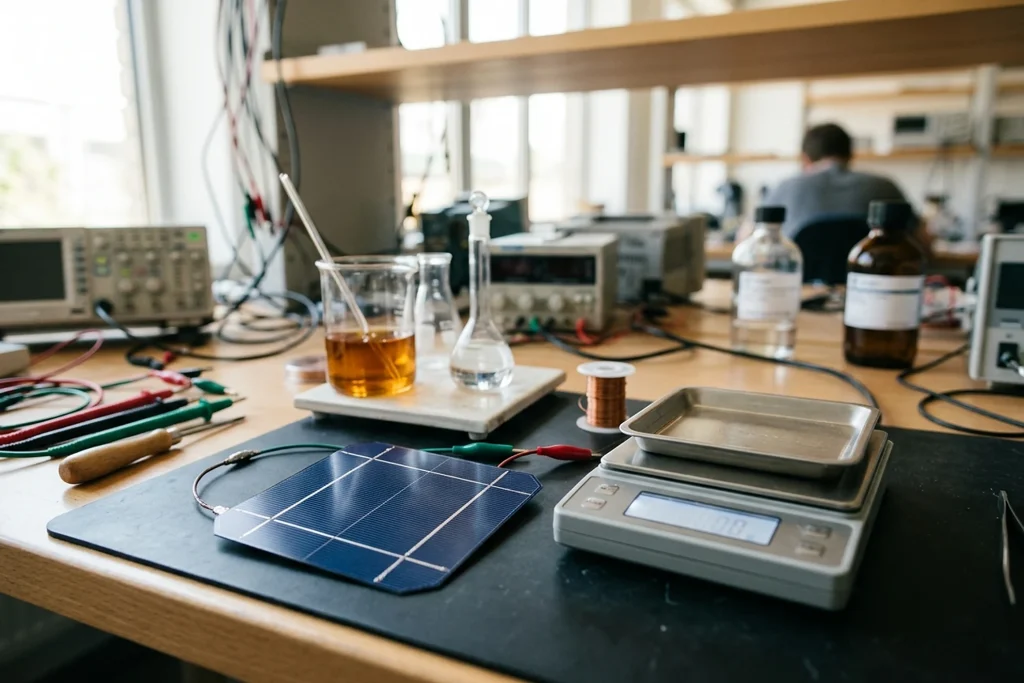
Photovoltaic solar cell production using a microwave is possible. Dr. Semiconductor’s video shows that solar cells can be produced at home using a microwave oven, and that silicon cells, although they may look complex, actually have simple structures.
The material can be purchased online. The following mixture is prepared to form a phosphorus-rich layer on a bare silicon wafer that can be purchased online: – 1 mL tetraethyl orthosilicate (TEOS) – 0.3 mL 85% phosphoric acid – 5 mL ethanol – 0.25 mL distilled water
The mixture is boiled over low heat for 30 minutes. The prepared mixture is then coated onto the cut silicon square using a rotating platform such as a PC fan. The silicon is baked for half an hour. The coated silicon is baked in a microwave oven at below 50% power; care is taken to prevent it from melting, as these ovens get very hot.
A thin glass layer forms. The thin glass layer that forms around the baked cell is sanded or etched, after which a gallium-indium contact is placed on the P-type side and an indium contact on the phosphorus-doped side. The cell reached approximately 5% efficiency. Cleanroom conditions could increase efficiency. An anti-reflective coating could also contribute. Efficiency could be increased with better contact. The full recipe was also shared in a blog post.
Why it matters
The fact that the recipe can be applied at home without requiring a cleanroom and with materials obtainable online shows that photovoltaic cell production can be brought down to a hobby scale. In this respect, the project offers an experimental ground for electronics enthusiasts and for those who want to gain hands-on familiarity with semiconductor technology. Although the approximately 5% efficiency achieved proves that the cell generates electricity, it leaves open the question of whether a usable energy source can be obtained with this method. The extent to which the improvements listed for increasing efficiency can be applied under home conditions also falls outside the scope of the recipe. The steps that demand care, from the preparation of the chemical mixture to the oven getting very hot, are a reminder that the seemingly simple recipe still requires attention and basic knowledge of materials.