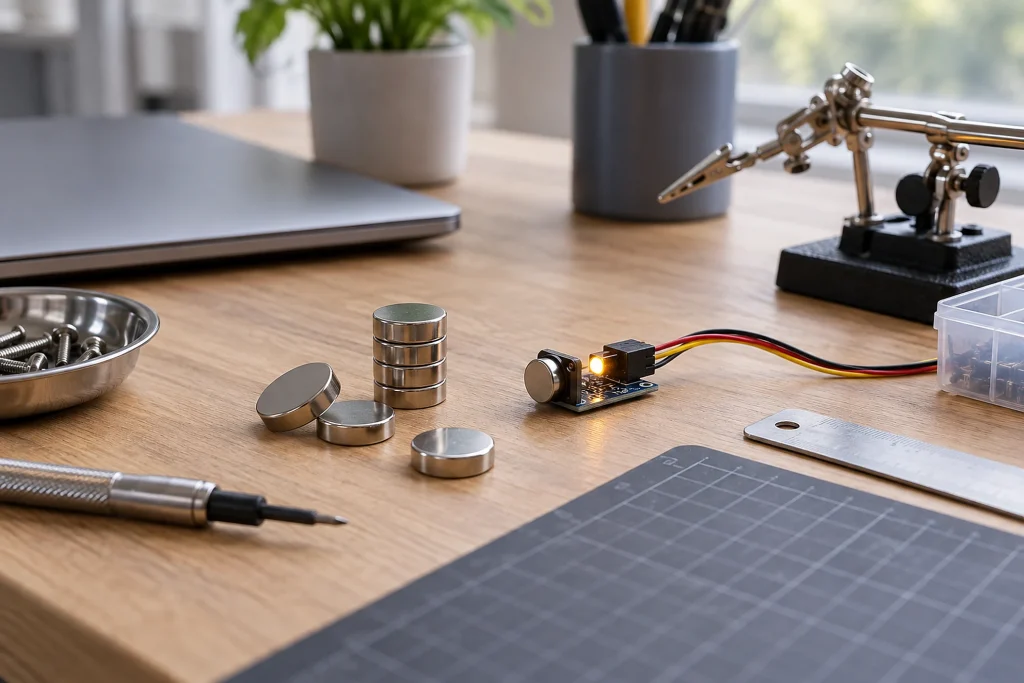
Correctly identifying the north and south poles of magnets is important to ensure consistent polarity when assembling components such as magnetic covers. [Clough42] explains several ways to identify these poles and how magnetic fields behave.
The easiest method is to use a reliable reference magnet with clearly marked poles: like poles repel, while opposite poles attract. If no such magnet is available, a compass can be used; the compass’s north end points toward the magnet’s south pole, and its south end toward the north pole. A Hall effect sensor or an electromagnet whose winding determines the pole based on the direction of current can also provide a measurement.
However, sensors may detect the orientation of the magnetic field rather than the pole directly. In the video, the sensor at 4:08 turns on the LED when the magnet’s south pole is held in front of it and the north pole is brought behind it. Similarly, when a strong magnet is moved in a phone app, the detected pole changes even though the magnet’s orientation does not. The identified poles should be clearly labeled for future reference.
Why It Matters
This topic shows that when assembling magnetic covers and similar components, not only the presence of a magnet but also its orientation must be identified correctly. Assuming the wrong pole can cause components expected to connect to repel one another or attract unexpectedly; therefore, the orientation information of parts used in workshop tasks and maintenance operations should be preserved. The fact that measurement tools can detect the orientation of the magnetic field means that the result obtained should not be confused with the magnet’s physical pole. This makes the choice of method dependent on whether a reliable reference is available and how directly the measurement can be made. The remaining question is how to explain to users why different tools can show different orientation indicators on the same magnet.