Researchers from the University of Chicago’s Pritzker School of Molecular Engineering, Harvard, Stony Brook University and Quantinuum have experimentally demonstrated all the operations required for universal quantum computing based on non-Abelian anyons. Published in Nature, the study provided the first experimental evidence that this approach can offer a sufficiently broad set of operations to run different quantum algorithms.
Because quantum computers are highly susceptible to errors, information is generally distributed across a large number of physical qubits. However, error-correction methods do not automatically provide all the operations required for universal computation on the protected information. Generating the “magic states” used to address this shortcoming requires a costly process known as magic-state distillation, which can consume a large number of qubits. The researchers said non-Abelian codes could eliminate this step.
Non-Abelian anyons do not exist in nature as independent particles; they are created in quantum circuits through the entanglement of many conventional qubits. Information is processed by changing their internal states when one anyon is moved around another. The order of movements matters in these “braiding” operations. Spreading information across many entangled qubits can also protect it against some small disturbances.
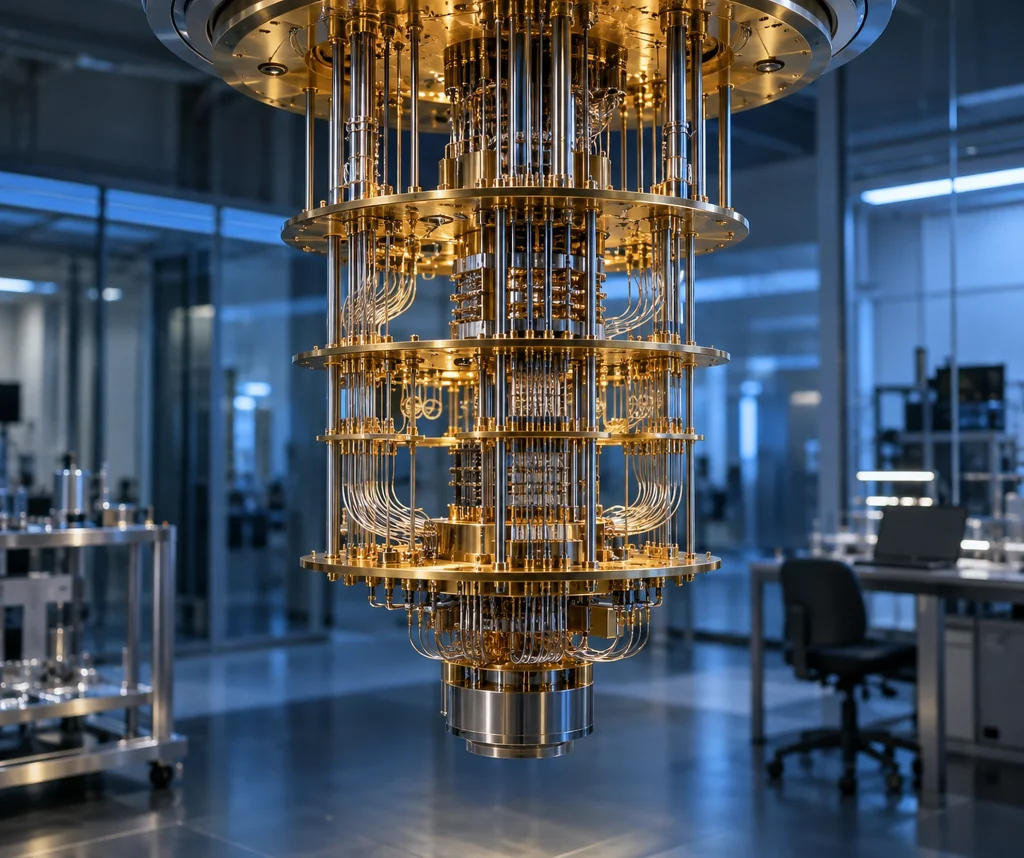
In 2024, the researchers created anyons on Quantinuum’s trapped-ion computer associated with the D4 symmetry group, which preserves the rotations and reflections of a square. However, braiding alone had not been sufficient for universal computation. In the new study, the team created anyons with 54 entangled qubits on Quantinuum’s H2 processor using S3 symmetry, which preserves the rotations and mirror reflections of an equilateral triangle.
Universality in the S3 system relies on using braiding together with a “fusion” operation. In this operation, two anyons are brought together and the resulting state is measured. Instead of binary qubits, the team created topological qutrits carrying three levels of information. Braiding enabled an entangling gate, while fusion enabled two different measurements. Together, these three tools make any quantum operation possible in principle, including operations that braiding alone could not perform.
The experiment also directly generated magic states through topological operations; however, active error correction was not applied. The researchers stated that the next step was to combine these operations with active error correction.
Why it matters
The significance of the study lies in showing a possible alternative to magic-state distillation, which is used to provide the range of operations required for universal quantum computing. This approach raises the question of whether the resources required to process information spread across many physical qubits in error-corrected systems can be reduced. The results open up a new area of investigation for both researchers and teams developing quantum hardware, with the goal of ensuring that quantum algorithms are not limited to only certain operations. However, the experiment did not actively test the method’s ability to protect against small disturbances during operation. The open question, therefore, is to what extent the demonstrated operations will be reliable and feasible in terms of resources when combined with active error correction.